After David Lynch passed, my social media flooded with tributes, memories, and stories about his art and his spirit. The same sentiment I saw when greats like Ursula K. LeGuin and David Bowie passed: Why do we lose these artists right when it seems like we need them the most?
I scrolled social media, hearing David’s voice, seeing his work, taking in his wisdom. The collective remembering and honoring was very powerful. I don’t think we’ve lost David Lynch. He hasn’t gone anywhere. His body died, but who he is, what he is, is still here.
I’ve yet to come across someone who could articulate the concept of the unified field or the collective unconscious so clearly as David.
I think, what happened, and what I witnessed, am witnessing, is this.
As we learned about David Lynch’s passing, we remembered him. We remembered the effect he’s had on us, and that his work will continue to have. We remembered the things about his presence that speak to us. And in that remembering, sparks of his energy wakened in each of us. We hold them. We hold him.
Who will be David Lynch now?
I think we all will.
He’s dispersed, now, among us. It’s up to us to nurture those things we find important and hold dear that are connected to David.
For me, that means prioritizing the work, as he called it. Focusing with intensity. Regular idea fishing. Remembering to take breaks and enjoy life. Being as particularly and unapologetically myself as possible. Loving what I love. Refusing to explain. More mystery. More dreaming. More consciousness. More art.
A friend recently informed me that I have “finished so many things,” referring to the short stories and novels I’ve written. I argued fiercely that I have never finished anything in my life. And, in fact, I petition that we throw out the concept of “finishing” altogether.
In my day job, I work with post-graduate writers in academia. The concept of perfection plagues some of these students. They could edit their work forever. Yet, they need to turn it in, in order to pass their courses and receive their degrees. So how do they know when their work is “finished”?
I tell them: Well, that’s what deadlines are for.
This advice is less useful for those of us outside of academia’s structure. We don’t have professors giving due dates. We might have a submission deadline we’re writing toward, but that won’t be a constant.
I propose we take a more Zappa-esque stance. Art isn’t something you finish. It’s something you work on, or that you stop working on, or that you start working on again, as you see fit.
This is tricky, though, because when do we know a piece is ready to submit for publication? How do we know when to present the art we’ve made?
I don’t look at older pieces I’ve placed, because I know I’ll find thirty-odd things I wish I could change. Those pieces, to me, are definitely not “finished.” I just stopped working on them, and editors and readers thought they were good enough to share.
I think working with the goal of finishing something implies a level of finality, a type of perfection, that we just aren’t going to attain. Our work on the page is not something to be perfected. It is an artifact from a version of ourselves.
I think the goal should rather be one of alignment.
In the present moment, this version of myself is satisfied with this version of the work. They line up. It’s a feeling of synchronicity, of, yes, this is what I meant to do. It’s a sign to stop.
We don’t finish; we just stop, and the piece becomes an artifact. It’s not a definitive, sublime form of anything. It’s just something we were satisfied with at some point–satisfied enough that we decided to stop working on it.
We could work on a single piece for our whole lives. It would evolve alongside us, because as we change, the art would also change, so that our satisfaction with it is maintained. Not everybody decides to stop. There’s nothing wrong with this! It’s down to the artist’s choice. Creating is a series of choices, whether those choices result in one thing or myriad. Marcel Proust worked on a single, massive novel, and I’ve never read a more beautiful opening chapter than that of In Search of Lost Time.
It’s up to us to decide what we want to work on.
I have a lot of ideas. There’s so much I want to do, so many things I want to try, and I am changing and deepening as a person at what feels like an exponentially increasing rate. I want to get to those other ideas. I want to leave a trail of artifacts behind, as many as I can. That means I have to stop working on projects at some point. I’m not finishing; I’m getting to that moment of alignment, where I’m satisfied with what’s on the page in the present, and I’m stopping. I’m not going to be satisfied with it in a month, in a year, in ten years, whatever. But right now, I am satisfied, so I’m going to stop. That moment of alignment tells me when to set something down and reach for the next.
I’ve been working on a short story this week that I had set aside a year ago. I sent it out, and nobody wanted it. So I started working on it again. I revamped and rewrote the ending. It now feels more complete, more correct. I’m excited to start sending it out again.
So, when we set something down, it doesn’t have to be forever. Because it’s not finished, we can always pick it up again. Sometimes the work needs to be set down in order to develop further at a later time. I wouldn’t have gotten to this better ending if I thought of the piece as “finished.”
The concept of “finished” cuts both ways–it can keep us from moving on to new work, and it can keep us from picking up old work.
“Finishing” something is an artificial concept, cold and dead, without roots in the natural world. It smells like factories and oil, like cardboard boxes and garbage dumps. It denies the inherent interconnectedness of existence. It denies the spiral of creation, and substitutes that ridiculously straight line.
Nothing is a straight line. Nothing is ever finished.
When I was a kid, magic was essential to my inner world. I read fantasy books full of witches and magicians and children with innate powers over the elements. I read about magic rings and wishing stones. I read about fairies and their glamours, about dragons and djinns.
In The Real World, there was no such thing as magic, unless it was black magic and sorcery, which was evil and must be avoided at all costs. Or so I was told.
But magic isn’t like that. And it isn’t a flashy, sparks-flying wand duel. It’s not turning into an animal or flying on a broom. It’s more like alchemy.
Alchemy, in the medieval sense, isn’t something I was familiar with as a kid, and I’m by no means an expert now. The loose-ish way I’m using it here is combining disparate elements to make something new and valuable. The medieval alchemists sought to make gold out of baser materials. Carl Jung interpreted alchemy as the steps toward individuation, or wholeness of the self.
I think art is alchemy. Or maybe I should say, art can be alchemy.
I didn’t truly begin to practice art as magic until I found my Material. I was writing long before that. But the pieces I wrote weren’t necessarily alchemy. I was honing craft, I was learning, but I wasn’t transforming. And that’s what alchemy is: transformation.
By Material, I mean those themes and ideas that are the closest and deepest heart of the artist’s lived experience. The places that are the most in need of exploration and healing. Maureen Murdock wrote about the Heroine’s Journey as not an external experience, but an internal one: journeying ever deeper within to recover the parts of ourselves we have discarded to survive in hostile environments.
The trick is, we can’t know our Material unless we know (1) who we are and (2) what has happened to us.
Maybe this seems elementary. Silly. “I lived my life; I know what happened to me!” But do you? Do you really know what happened, and the significance of those events? Do you know what parts you have buried deep down in the dark of your subconscious?
Who we are is at the root of our actions and reactions. Who we are is shaped by what we has happened to us. That is our Material. Until we find it out, we cannot use it.
There are so many reasons we might not know ourselves.
The mind protects us from pain. It hides memories. It shades the past with rose-gold sparkle. It denies that we have suffered, that we could have suffered at the hands of friends or family, because those people love us and would never hurt us. It conceals identities that are unsafe to live outwardly.
Capitalism rushes us ever onward without a moment to rest or reflect. And if we do have moments, the endless data stream that is the internet clamors for attention. We have families, children, spouses. We have jobs, households, obligations.
I think a lot of people might find their Material sooner than I found mine. Some people probably find it even later in life.
Once I found my Material, I put it into my alchemical chalice: into words on the page. Blending, my Material and my skill flowed together into writing that was urgent, aware, responsive, authentic. I had something to say. I had a perspective. I wasn’t writing just to tell a story. I needed to write this.
The story on the page was big and beautiful and upsetting and terrible and glorious. The story made demands. I had to explore deep, difficult emotions. I had to take parts of myself and infuse them into the story: alchemy. In using my Material, I was creating the most true thing I had ever written. In using my Material, I was healing myself.
That is the second alchemy, the second magic. That when artists use their Material to create, brokenness in them begins to become whole. We make ourselves when we make our art.
Then, perhaps, we present the creation, the byproduct of our alchemy, to others. Our creations can engage them in an alchemical process of their own. And this is the third alchemy.
I think alchemical art sings louder, shines brighter in general. But it doesn’t necessarily speak to all people. I’ve read a lot of books. There are plenty out there that are not magic. And by that I mean, in which I do not find myself, in which I do not make myself more whole. That doesn’t make them bad art or even bad books. The artist may have found magic. Someone else may find magic. But paths to wholeness, though they may overlap, are not identical. This also is beautiful.
The northern hemisphere turns to autumn, transforming itself in preparation for the long dark of winter. If we live with the rhythm of the seasons, we prepare to turn inward toward our own inner dark. What will we find there? What parts of ourselves will we recover? What alchemy will we perform?
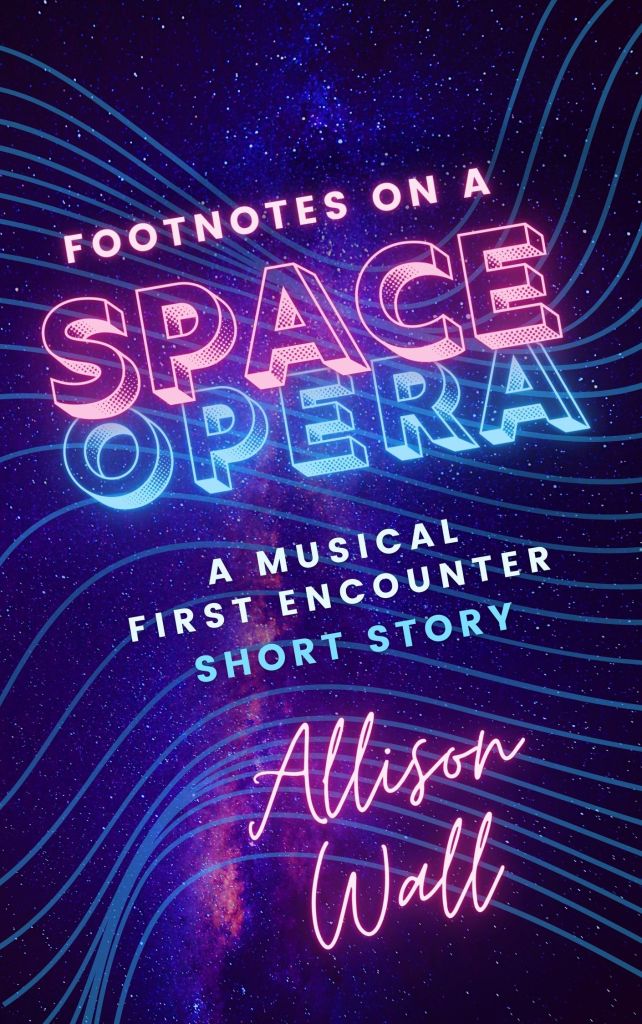
Here we are, just vibing in the apocalypse…and I hope to distract from the arguably grim national and international current events with some updates regarding my upcoming short story publication, FOOTNOTES ON A SPACE OPERA!
Cover Reveal!
I have a finalized cover design!
I was very intimidated by this aspect of the indie publication process. I couldn’t find anything on pre-made cover websites that fit. And I knew I couldn’t design a professional-looking cover myself.
I tried anyway, though. I played around on Canva (free online design software easy enough for the *ahem* design-challenged to figure out). I came up with a concept I liked, and then passed it along to the brilliant Danica Redfern, a fellow writer and pro designer, who gave it movement and brought it to life.
Ready?
Here it is!
What I love about it
(apart from everything)
The whimsy and fun of the colors
The movement of the sound waves across the back
That the sound waves look like the lines of a musical grand staff
The font, which reminds me of those good old marquee signs and neon lights
So if you just can’t wait (or if you’re absent-minded like me and want to make sure you don’t forget) head over to Amazon, put in that pre-order, and on September 6, when the short story is officially published, it’ll download right to your device. All ready for some Labor Day alien invasion.
Even after hitting “Publish” on this post, I still don’t know how I feel about the title statement. How it’s worded, I mean. The ideas it represents are absolutely true.
On November 9, 2020, I was assessed as having met criteria for Autism Spectrum Disorder (ASD) and attention-deficit/hyperactivity disorder (ADHD). In other words (and maybe words that I prefer), I’m neurodivergent.
I know this may feel out of the blue to some people. It is to me too, in a way, but in another way, it’s an “of course” lightbulb moment, a flashpoint, where all the experiences of my life have come together to make sense.
So I wanted to have a record of what led to this point in my life to share with you all. I am far more articulate in writing than I am in person, and with the ongoing COVID-19 risk to social gatherings (and my own inclination to spend most of my time alone), I thought this would be the most efficient way to let you all know what’s been going on in my life related to my own neurodivergence.
The Highly Sensitive Person / Sensory Processing Sensitivity
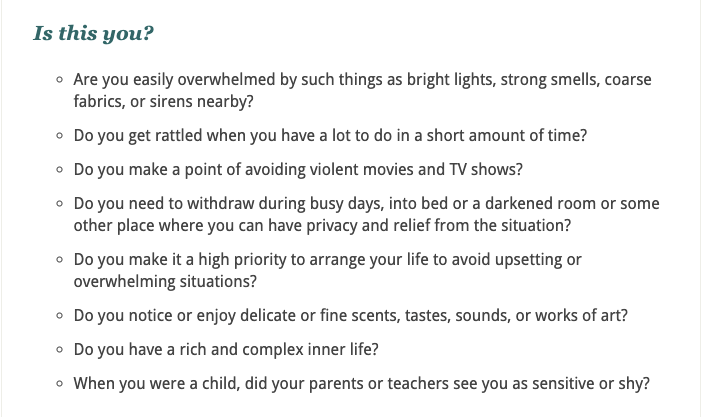
Back in the winter of 2018, I stumbled across a term I hadn’t heard before, but that explained a great deal about the way I experience life: Highly Sensitive Person (HSP). This is a term coined by Dr. Elain Aron, a psychologist, scientist, and researcher, who noticed in herself and subsequently in her studies a natural inclination for about 20% of the population to exhibit heightened sensitivities to sensory stimulation. HSPs have more sensitive central nervous systems, are more easily overwhelmed by sensory input, and tend to take longer to process new information. They have a tell-tale tendency to “stop and check” before entering new situations. Another term for HSP is Sensory-Processing Sensitivity.
Here’s a screenshot from Dr. Aron’s HSP website’s homepage.
I read her book, The Highly Sensitive Person: How to Thrive When the World Overwhelms You, and marveled about how all of the areas I struggled with as a child, and continued to struggle with as an adult, could be fit under this one umbrella term. (I could go into a great deal of detail here about what in particular about my life experience matches an HSP one, but for now, I’m going to stick to chronicling the general timeline leading up to the official recognition of my neurodivergence.)
I began examining my behavior, my experiences of the world, and my past through an HSP lens. A lot of things were making more sense to me, and to an extent, I was able to modify my interactions with the world and other people to be more in line with my comfort zone, which I had been blatantly ignoring or feeling guilty about not ignoring my whole life.
But after a while, I realized something didn’t feel…right. Dr. Aron talked about HSPs as having great gifts and the HSP trait as an advantage. On paper, I agreed, but being an HSP didn’t feel like an advantage to me. It felt like, well, a disability.
This isn’t a word I use lightly. I wrestled with it mentally for a long time, but the more I wrestled the more I felt that, yes, I feel dis-abled (see this fabulous TEDTalk by Autist Jac den Houting in which she says, “I am not disabled by my Autism; I’m disabled by my environment.”) by these traits that (according to Dr. Aron) are supposed to be strengths.
I strongly believe I never would have gotten to this point of understanding if I hadn’t deconstructed the conservative, fundamentalist religious influence, mindset, and worldview I grew up practicing. Some people I know might not like this, might feel off-put, might shut me out because of it, but it’s true, and it’s important. Since about 2016, I’ve been engaged in a long, arduous process of re-examining things I took for granted as truths for my entire life. Part of that has involved learning how to trust my instincts and my lived and inhabited body knowledge. That they aren’t sinful urges to be ignored or temptations to be gutted through. After spending over 20 years ignoring intuition, pushing past my own limitations daily, it’s daunting, trying to reclaim boundaries, self-knowledge, and self-trust. But I was trying. And my lived experience was telling me that HSP wasn’t it. Not all of it. I wasn’t through learning about myself. There was more work to do.
In March 2020, I reached out to a couple of local therapists who claimed specialization in–or at least knowledge of–HSP. I figured maybe I just wasn’t understanding how to work with my HSP traits, that maybe this feeling of dis-ablement could be mitigated by picking up some tips and tricks. Then the pandemic shutdown happened, and I never reconnected with them. There were more important and distracting things going on the in world.
In the summer months, I started to pick up where I had left off. I hadn’t felt comfortable with either of the therapists I’d talked to in March, so I did more googling. I stumbled across this article, which posited that HSP traits in females could really be female Autism. Following that rabbit trail, I found other sources like this YouTube channel run by a British woman who is Autistic. Like me, Sam was diagnosed with Celiac disease, identified as HSP, and finally, sought an assessment for Autism, and found she met the DSM standards to be considered on the spectrum. I found videos like this one in which Autism expert Tony Attwood talks about the characteristics of females with “high-functioning” Autism (commonly known as Asperger’s Syndrome before the update to the DSM-5 removed this label, confusing many and robbing many of an identity they’d come to claim with pride) and of the crises unidentified female Autists go through, including anxiety and depression.
I found this unofficial list of female Autistic traits. I was shocked. I identified with something like 98% of the traits compiled.
I took online quizzes (here and here). With the consistent result: high possibility of neurodivergence and/or Autism.
“You don’t seem Autistic.”
Until August 2020, I would have wholeheartedly agreed. Turns out, the reason I don’t “seem Autistic” has less to do with Autism and my own neurodivergence and more to do with false stereotypes of Autism that are deeply rooted in decades (if not centuries) of sexism and gender discrimination that have affected the very development of the fields of medical science, psychology, and the Diagnostic and Statistical Manual of Mental Disorders (DSM) itself, the bible of psychological “disorders” used to “diagnose” the mental “disorders” we see in the Western world.
There are fundamental differences in how individuals on the Autism spectrum may behave, but until very recently, they have not been recognized. This is due in part to the fact that, when conducting trial studies and tests, psychologists have consistently chosen cis-male subjects. For more on the history of this, and info on neurodivergence in women, I highly recommend Divergent Mind: Thriving in a World that Wasn’t Designed for You by Jenara Nerenberg. This book literally was published in 2020, and would not have been available to me if I had started this research ONE YEAR AGO.
After an intake appointment in which my assessor agreed there was sufficient evidence to proceed, waiting four weeks for my appointment, four hours of testing, two weeks of waiting for my assessor to analyze the data, I learned in a video call that I met criteria for Autism Spectrum Disorder, Level 1 (the lowest level of assistance needed; the DSM-5 goes through Level 3), what would previously have been known as Asperger’s Syndrome, and in a surprise 2-for-1, I also learned I met criteria for ADHD, inattentive type.
Here’s a distinction that’s important: I was not identified as Autistic, ADHD, or neurodivergent by the experts. At age 30, I identified myself, and then sought an expert to officially reinforce what I already knew to be true.
The medical, psychological, and social systems in my life failed me.
This is especially depressing, because as a female, the world had already failed me in so many ways. I was socialized to fly under the radar. I was socialized to “get by” without accommodation, to put others’ needs before my own, and I was smart enough that I could manage. Barely. But the resulting depression and anxiety for constantly struggling to fit into a world where everyone else seemed to fit in easily made life miserable.
I would like to note that my assessor was a lovely person. She was knowledgeable about ASD in women, and delivered the results in a kind, considerate way. At one point, she told me, “There’s nothing wrong with you.” I believe this is true. But I also believe that I am not in the category of what is considered “normal.” She expressed her desire for the day when neurodivergences are understood as a spectrum, rather than disabilities, and I wholeheartedly agree.
ADHD?
I still don’t fully understand the implications of this piece. I haven’t done nearly as much research here. But I do think ASD and ADHD together may explain things that look contradictory, like why I thrive on a schedule, but also have trouble sticking to schedules.
What Now?
As I once again reframe my life experiences through these new lenses, I am heartbroken for the little girl I was, and for the ways my life might have been easier, better, happier. I am also viciously proud of myself for accomplishing things that were desperately hard for me. Singing the lead in a musical. Singing the lead in an opera. Traveling internationally. Graduating with my master’s degree. I didn’t know other people didn’t struggle this much or in the ways I struggled.
My hope is, with this new understanding of how I perceive and interact with the world, I can build a life that allows me to thrive, that makes me happy more often than sad, and that enables me to reach my highest potential.
I also hope I can bring empathy and understanding around the issue of neurodiversity and dis-ability. The experts and Autists I found online were overwhelmingly not-American, and I believe my country is behind on this issue. If you want to talk more with me about this, please reach out. The world is a big, scary, and unsure place. Caring for each other is what makes it beautiful.
*Minutes before publishing this post, I wonder if I’m making the right decision, sharing this information so soon after receiving it myself. I am convinced, though, that staying hidden, masked, and under the radar–the way I’ve been living for my whole life as a neurodivergent person–will not help me or anyone else, and that if I don’t act on the information I’ve received, I might as well not have sought clinical affirmation at all. And, I remind myself, if this makes me feel socially awkward or uncomfortable, that is nothing new. 😉
* This post was edited on January 3, 2021 to remove and reword language including the word and variations of the word “diagnose.” I no longer use the word “diagnose” in relation to my neurodiversity, as it implies an illness or medical condition. Neurodiversity is not an illness. I am not sick.
Definitely some rough days where my mental/creative energy output wasn’t sufficient to hit that magic number (1,667 words). I gave myself a break, though, and didn’t force it. I was able to catch up on subsequent days, and am still on track for 50k by November 30.
Having someone to write with and talk about daily progress with has been crucial. I have a friend out of state who messages me from time to time, and another friend I’m luck enough to share office space and literal writing time with. We had a long discussion yesterday about our manuscripts, and it was pretty great. I highly recommend getting a writing buddy or three. My NaNoWriMo site handle is awritingwall. Look me up, and I’ll be your buddy!
The outline is still holding up! Totally shocked: me. I did have one little moment where I felt the urge to explore a scene that wasn’t on my outline, but I made a note of it, and kept going. When the word count is queen, there’s no time for exploratory writing…at least, that’s my current philosophy. I’m doing that every now and then: creating a comment in my Word doc of things I want to go back to, to tweak or expand, but don’t have time for right now. That’s allowing me to mentally stay focused on plowing ahead.
The pacing of the story seems awfully fast. I have a theory that the mental state of the writer has everything to do with how fast/slow the beats of the story happen. My brain is pushing the story forward to meet word count goals, so it makes sense that things would feel rushed. We’ll see how this develops. I have a feeling, though, that this story will need to be slowed way down and fleshed out a ton. I already see many, many places where I’m BS-ing my way over details that really do need to be addressed.
THIS. IS. FUN. It feels so great to get a story down in words, and feel like you’re really making progress on a whole book. Finishing up a word count goal for the day, I’m drained, but in a happy, satisfied kind of way, a bit like a runner might feel after a solid work out. That’s a guess. I’m not and never have been a runner. But it seems comparable. Runners out there, feel free to come at me. Tell me about your lives, and what it’s like to be fit and active.
All right, y’all, almost halfway done.
LET’S DO THIS.
♥
(My NaNoWriMo site handle is awritingwall. Look me up, and I’ll be your buddy!)
Novel outlining methods look so great on paper. Everything is in neat steps. You basically have an organized checklist for writing 50k+ words. But none of them work for me.
A large part of being an artist is understanding your own creative process. If you can learn to work with yourself, your strengths and weaknesses, patterns of burnout and inspiration, your schedule, and work with persistence, there’s a pretty good chance of improvement.
I feel like I have a pretty good handle on my day-to-day creative process. I know the kinds of environments I can do certain kinds of work in, how to get myself at the desk, and so forth.
My long-term creative process has been mysterious–partly because I’ve been mostly in the thick of it for the last couple of years. Can’t see the forest for the trees. That kind of thing. But I’m approaching the finish line (read: my self-imposed deadline because I need to be done with this book) of a long, long cycle of novel writing and revision. I’m getting to the edge of the forest, and I’m gaining perspective on my long-term writing process.
I’m a pantser. That’s writer-speak for: I prefer to write new stuff without planning ahead and discover what’s happening as I go. The opposite would be a plotter, someone who writes outlines, knows how many chapters they’re going to have, and so forth.
George R. R. Martin (A Game of Thrones) has more poetic terminology:
The architects do blueprints before they drive the first nail, they design the entire house, where the pipes are running, and how many rooms there are going to be, how high the roof will be. But the gardeners just dig a hole and plant the seed and see what comes up. I think all writers are partly architects and partly gardeners, but they tend to one side or another, and I am definitely more of a gardener.
Being a pantser/gardener is exciting. It keeps me interested in the project. The problem is that it seems to drastically increase the amount of time I spend drafting. I’m not sure when something is “done” because I have no idea what my goal for any particular scene/chapter/plot line is. I’m the fairy tale character who left the path and is wandering around in the woods, hoping to find the magic whatever to do the thing.
At various points during the writing of this particular book, I got sick of being lost in the woods. I attempted to plot. But very quickly, frustration with being lost turned into frustration with plotting. I never stuck with it very long.
So, slowly but surely, I made my way to the story that’s now in the hands of beta readers (god help me).
I have multiple writer friends who seem to be able to make this linear process work for them, who outline whole books before writing them, who ask confounding questions like, “How many drafts have you written?”
In her book The Heroine’s Journey, Maureen Murdock (quoting Sheila Moon and her book Changing Woman and Her Sisters: Feminine Aspects of Selves and Deities) talks about the creative process as having both masculine and feminine sides. (I don’t think these terms are any more gendered than yin and yang, but I’ll let you be the judge of that.) The masculine side of the creative process involves a linear progression from start to finish. Here are the plotters, the “architects” as George R. R. Martin calls them. Decision-making, forward motion, clear progress.
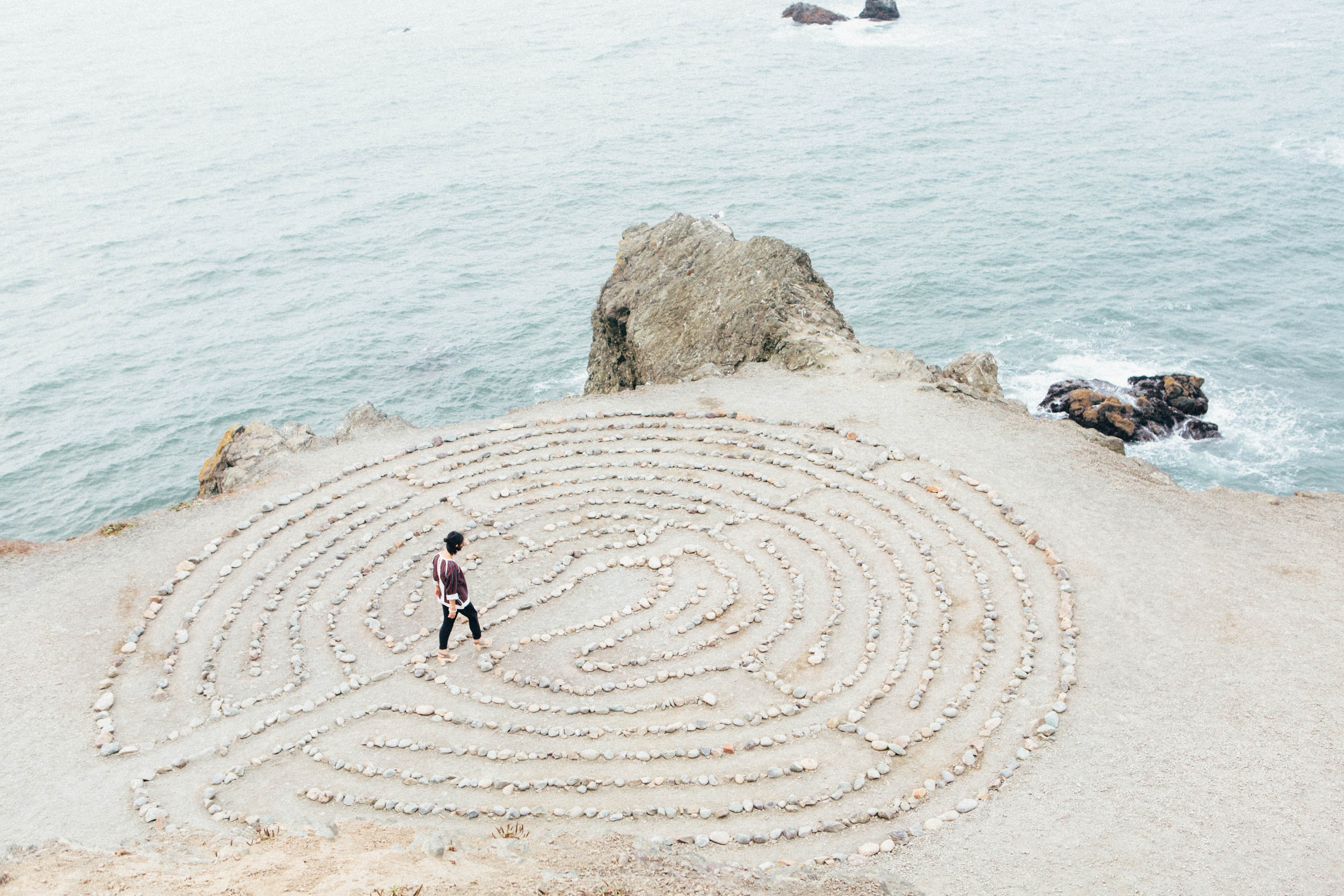
The feminine creative process moves not in a straight line, but in a spiral. Intuitive. Ever closer to the center, circling, narrowing, nearer and nearer to completion.
The process of my maybe-almost-finished book has a strong spiral shape. It has involved times of great productivity and breakthroughs, and times of waiting, or confusion, backtracking, and starting over. It can be maddening to wait and trust a process that seems circular, without realizing it really is spiral-shaped, and constantly angling closer to the center.
It would be nice if I could write a book from start to finish in straight-forward, sequenced steps. Instead, it’s a murky struggle for understanding. Somehow, though, that feels right. The novel is a long form that tends to be concerned with the way people live their lives, or a portion of their lives. And living, in my mind, involves a lot of murky struggling for understanding. So maybe it’s fitting that my process imitates the very thing the form is trying to capture.
I’m reading the novel 1Q84 by Haruki Murakami (totally recommend, though I’m starting to take issue with 800+ page novels; they’re EXHAUSTING). There’s a character in it who’s an aspiring fiction writer named Tengo. He has a revelation part-way through the book. He realizes he’s never really been passionate about anything. He’s performed well in school and in work because of people’s expectations. But when those expectations are taken away, he drifts. He writes when he can, but none of his work finds real success. This changes when he ghost-writes a fantastical novella. This story itself and the process of re-writing it changes him. For the first time, he feels for the first time a passionate need to tell his own stories.
These days, I feel very much like Tengo, pre-revelation. I either don’t have the right motivation for this fiction-writing work, or I haven’t discovered it yet.
I am starting to believe the reason you start writing is not the same reason that will sustain continuous writing.
Starting a new project is joyous. There are endless options, and the world of my imagination spreads out before me like Willy Wonka’s candy garden, all glittering jewel tones and unlimited possibilities. But as soon as I start writing, I start making decisions. I prune the paradise of options, sometimes haphazardly, and sometimes I kill the best parts without knowing. One day I realize the story isn’t working. Revision is hard work. I know it’s supposed to take a lot of drafts, but I didn’t realize it would be this many.
Beginning a purposeful writing life is also joyous. I am now a Writer. Visions of solitude, tea, coffee, rainy days, and fountain pens dance in my mind. But at some point, the solitude turns lonely. The tea is gone. And the story I’ve poured so much time into is still lying there like a corpse. Twitching now and then, but mostly dead.
In both cases, what got me sat down in the chair, pen in hand, and what prompted me to choose a writer’s life, has run out.
I don’t want to write.
Does that mean I should make myself anyway? Utilize that childhood lesson to always finish what you start? After all, Neil Gaiman said that you only learn from finishing things.
Or does that mean that this novel is one giant dead end, that I’m wasting my time on it, and my sluggishness and lack of love for it is an indication that I should just move on?
I don’t know.
I’ve been listening to Frank Zappa recently. He’s got some amazing views on art, some of which I talked about in a recent post. In order to compose (create art), Zappa says,
Just Follow These Simple Instructions:
Declare your intention to create a “composition.”
Start a piece at some time.
Cause something to happen over a period of time.
End the piece at some time (or keep going, telling the audience it is a “work in progress”).
Get a part-time job so you can continue to do stuff like this.
Ending a piece, finishing it now doesn’t mean you have to be finished forever. Maybe you are. But you can always decide you aren’t finished and start again.
Zappa put out over 60 albums in his lifetime. I wish I had a fraction of his carefree attitude or determination or whatever it was that constantly motivated his art.
But I’m also afraid that what I’m really experiencing is not some deep, metaphysical need for a motivation, but my inherent flakiness and tendency to be easily bored with what I’m doing. Impatience. My own insecurities in my abilities, intelligence, and vocation as a writer. Or some such toxic combination.
So I decided I had reached the end point with my novel. For three weeks I tinkered with side projects (some flash fiction, a piece involving cyborg pirates), and remembered what it felt like to enjoy the work. And then, out of the blue,
AH-HA
I identified an element of my novel that, whenever I try to introduce it, stagnated the story. So I cut it out, backed up, and wrote forward again. I think this may be the right (or at least a better) direction. In any case, writing new material feels exciting again. Whether that has anything to do with the story’s progress has yet to be seen.
So I guess the right time to finish a story is if you put it away and never take it out again. Give yourself permission to declare the composition finished, even if it’s not Done. It may help you to tell yourself, “I’m never touching this garbage heap of a story ever again.” Fine.Work on something else.
If nothing in you or in the world around you calls you back to the story and you forget about it, then let it rest. You ended the piece, so it’s finished.
My novel drew me back in. So I keep writing. It’s a work in progress.
And I have a part-time job, so I can continue to do stuff like this.
I recently tried a revision experiment with a short story of mine, and I believe the results have implications beyond the piece. So here’s a case study on revision from my writing life…
A few years back, I wrote this short story I really loved. It felt complete, had a cool time-travel concept, and an interesting ending. I researched speculative fiction journals and started sending it out a year ago. I sent it out a lot. A lot. And it was consistently rejected via form e-mails. I know that rejection is a big part of the writing game, but I was legitimately confused about why no one seemed to want the piece.
I watched The Shining for the first time about a month ago. I know, I know, I really should have seen that one already. I’m just now starting to get into the horror side of speculative fiction, H. P. Lovecraft and Stephen King and etc. I’m super behind. (All book/author recommendations welcome below!!)
The point is, as I was watching, I realized that without ever having read or seen The Shining, I had it ripped off in this short story. Not the plot, but the setup: guy takes care of ski lodge over the winter. Things happen. Etc. The similarities were undeniable.
Of course no one wanted the story. Every single person who screened it has seen The Shining. I’m like the only speculative fiction in the world person who hadn’t. And I was mad about it. How was I supposed to know I had ripped off a movie I had never seen?
Watching The Shining like, “You’ve got to be kidding me.”
I stewed about it. I didn’t want this piece to die a slow death in my Dropbox folder for such a ridiculous reason. I’ve been wanting to write some speculative flash fiction for a while. This seemed like a good opportunity. On a whim, I decided to cut it down to a flash fiction piece. I’d turn a 3,000 word short story nobody wanted into a 750-word flash piece no one would be able to resist.
I was a little intimidated. But I was also frustrated. And I love de-cluttering. #minimalism.
I slashed 1,000 words without breaking a sweat. It was amazing how much bulk the story had been carrying it didn’t need. The story could do without so many of the paragraphs I had slaved over. Without all the excess, I could see the heart of the story in a deeper, clearer way. I even came up with a new ending, one that fit the story so much better than the one I had.
At 1,800 words remaining, I started doing a lot less backspacing and a lot more staring at the screen. How on earth could I cut 1,000 more words? I’d be amputating essential limbs, cutting out organs the story needed to survive. As a last resort, I tried condensing two scenes. It didn’t work.
I left the piece alone for a while, came back to it, ready to try to squeeze it down to at least 1,000 words. It wouldn’t squeeze. So I stopped trying. I decided some stories aren’t supposed to be flash pieces.
That might sound like surrender. I didn’t meet the goal I set for myself, after all. But I learned so much about the story I had been trying to tell and so much about what is essential to it. I’m confident in sending it out again, reincarnated and slimmer.
We writers think through words. As we think, we leave them behind on the page. A great majority of this mental processing flotsam isn’t for the story. It’s for us. Terry Pratchett once said,
The first draft is just you telling yourself the story.
I might add that sometimes we need more than one draft to tell the story to ourselves. But this is a necessary step. If we don’t know the story, we can’t tell it to anybody else. So we write, telling ourselves the story on the page. This is the fun part for me. But in revision, we have to figure out what is there for us and what the reader needs, which parts of the work exist to lead us to the real story and which parts are the real story.
For example, in the piece I slashed, I originally started with a phone conversation in which the protagonist is interviewing for the job taking care of the lodge. That scene functioned to get me into the story. It helped me understand who my protagonist was and how he got to the place where the story could start. But it wasn’t the heart of the story. I cut the whole conversation.
It’s not often easy to figure out what parts are for you, and even if you have, it’s not often easy to cut them. Annie Dillard devotes the beginning of her gorgeous book The Writing Life to throwing work away.
The part you must jettison is not only the best-written part; it is also, oddly, that part which was to have been the very point. It is the original key passage, the passage on which the rest was to hang, and from which you yourself drew the courage to begin.
The part you must jettison is not wasted. Getting caught up in that mindset can be dangerous and disheartening. No work is ever wasted. It served its purpose.
In her best-selling book The Life-Changing Magic of Tidying Up, Marie Kondo says something similar to give clients permission to give away unused gifts. It’s acceptable to give them away because that item has already served its purpose: you received it, and along with it, the love or appreciation it conveyed to you from its giver. Be thankful, and then let it go.
Work you jettison has served its purpose. It got you to where you are. So appreciate it, thank it out loud if you need to, and throw it away.*
♥
*It can be easier to delete if you save a backup copy of the document in another file. That way, you know you can go back to an old version if what you cut turns out to be a horrible, horrible mistake. In my experience, something once cut never finds a place in the work again. You decided it could be cut for a reason, after all…
There are two kinds of writers. Those who love writing first drafts, and those who love revising. I love writing first drafts. The first words of a new idea open a hidden door into a new world. Writing the first draft is exploring it, breathing foreign air, seeing new places unfold, and strange characters share their secrets.
I write fast, excited, and as I’m prancing along in a euphoric state (“These are the BEST four paragraphs I’ve ever written! I LOVE the concept of steampunk dirigible pirates! That’s TOTALLY never been done before!” and other delusions) I leave huge knowledge gaps in my wake.
In my last post, I talked about novel writing as a process of sifting and identifying of the unknown. Fiction in any form does not allow anything to be unknown to the writer. What you don’t know always shows on the page.
Insert anecdote.
The first time I submitted a short story to a workshop, my peers discussed my protagonist’s apparent ambivalence to what happened in the story. They couldn’t tell what he wanted or how he felt about events as they happened. From what they read, they couldn’t define his central desire. So they asked me. I didn’t know either. I hadn’t even thought about it.
This discovery proved valuable, and frustrating.I have a consistently difficult time understanding and developing my protagonist’s central desire. Even if I attempt hyper-vigilance as I write, I don’t see into characters’ hearts; I see their actions.
Not knowing a protagonist’s central desire or motivation is a huge vulnerability to any story. Protagonists push plots forward by making decisions based on a central desire. What they want, how far they’ll go to get it, and whether or not they succeed define the scope of the story.
If I let my protagonists make decisions before I understand their desires, I steer them into situations that do not serve their desires, and therefore undermine the plot and the story as a whole. The same thing happens if I lose sight of my protagonist’s central desire or change it partway through the story.
This is part of the reason I’ve had difficulty in plotting to the end of a novel I’m working on. I have tried a couple of different trajectories, but they weren’t right. They didn’t fit the story. I had tried to move forward without taking the time to understand, define, and prioritize my protagonist’s central desire.
Many times I have tried to sit down and verbalize what a character wants and map their actions forward from there. But I’ve found a character’s desire is almost never immediately accessible to me. Maybe a better way to say it is, my characters’ motivations are never complete, or static. They evolve. They clarify in incrementally advancing waves. Each revision, each new, better draft, lets me dig one layer deeper and see one click more in focus. Like at the optometrist’s. Two is better. Three is great. Four is like I’ve got bionic, telescopic eyesight.
And it is my knowledge of character motivation that develops, not the character’s motivation itself. Flannery O’Connor wrote,
You would probably do just as well to get that plot business out of your head and start simply with a character or anything that you can make come alive. … Once you have done a first draft then read it and see what it says and then see how you can bring out better what it says.
I see what my characters do, not what they feel. But in what they do, characters reveal what they want. Their motivation is already on the page in a gesture, an offhand remark. Even when I can’t articulate what a character wants, the character already knows, and is showing me on the page. It’s up to me to notice it, interpret it, in order to “bring out better what it says.”
So, what if we want to understand our characters more fully, but the page doesn’t seem very willing to help? Here’s a few things that I’ve found useful in the past.
Think outside the page. Switch up your process. You may be too trapped inside the page to see what it says. Make lists of things like character desires or objects in a scene. Draw flow charts of timelines, emotional reactions, and potential character choices. The goal is to get your brain thinking about the story from a new angle, one that might let you glimpse what you don’t know.
Take a break. Put the manuscript away, even for a weekend, but the longer the better. Sometimes time is the best thing you can give a story. Your brain will forget the exact sentences and you’ll come back to it fresh and ready to REVISE. (Ugh.)
Get some feedback. Give the manuscript to a trusted friend, ideally another writer, or a very well-read reader. Ask specific questions about your work. Things like, “Are there any places that seem fuzzier than others?” and “What do you think my protagonist’s motivation is?” You can also have them tell you what the story is about so you can gauge their understanding for things you’ve left out.
I’d love to be able to say that I have conquered my writing weakness, that I always know what my protagonists want, but I don’t. I’m working on it. As they say, admitting you have a problem is the first step to recovery.
In my case, “recovery” is that brilliant work I envisioned when I wrote the first draft. The work that will share the thrill of discovery with a reader.


 Allison Wall