Hi all! Long time, no post! Just dropping you blog-readers a line to let you know that I’ve published a new essay via The Art of Autism. It’s a fierce critique of Netflix’s new satirical film, Don’t Look Up, which features a disturbing portrayal of an autistic-coded villain.
This is very much the kind of content I write on this blog (and if no one had picked it up, it likely would have featured here!), so I think you’ll enjoy it. It’s titled, Don’t Look Up: A Masterclass in Autistic Ableism.
Let me know your thoughts either in the comments here, or over on The Art of Autism’s site!
Before my first appointment with the clinical psychotherapist who assessed me, I knew I was autistic.
As I talked about in a previous blog post, the education, mental health, and health care systems did not identify me as autistic; I discovered it on my own at age 30, like so many other women whose neurodiverse traits don’t match the stereotypical male presentations.
So if I knew I was autistic, why did I bother to go through all the stress, expense, and time to get an official assessment of Autism Spectrum Disorder in a pdf? (Especially now that I’m 30 and ancient of days?)
Great question.
1. Things weren’t going so great.
There’s a mentality among some that if I’ve made it this far in life without an official recognition of my neurodiversity, that everything must be fine. This is far from the truth.
Yes, I was an “A” student. Yes, I graduated from a master’s program with a 4.0 GPA. Yes, I am employed.
But my life post-structured school environment was at loose ends. The world around me seemed to be getting more and more intrusive as I felt more and more sensitive to all sensory input (the seams of my clothes, ambient noises, foods, interruptions, smells). I had several part-time jobs, but couldn’t afford rent on my own. I had trouble keeping all but a small handful of friends. I was anxious. Periods of depression were coming more often and lasting longer. I wasn’t happy. Everything felt harder for me than it seemed to feel for my peers. I had started to feel disabled.
When I found out about how autism looks in women, I knew I had a potential answer. And I knew I needed help with that answer and all its implications.
If things aren’t going great, it’s always a good idea to seek help. Partly because I’m autistic, though, I prefer to do things on my own, including research. I wanted to go in to a professional for help, with a strong, clear idea of why I needed help.
2. Self validation.
I needed to prove to myself that my assessment of myself was accurate. Self doubt and the need for external validation is a problem for me, probably from years of anxiously and unsuccessfully navigating social and health care systems. I am also extremely empathetic, and it can be difficult for me to tell whether emotions or experiences I’m learning about are mine, or if I’m taking on the emotions and experiences of others. I’m also a bit of a hypochondriac. I was 90% sure I was autistic, but I needed an official’s opinion for the last 10%.
This might not be necessary for everyone. If you’re super confident in your own understanding of yourself, all the better for you! I am more than a little jealous of your self-confidence.
3. Social validation.
I wanted backup if family and friends didn’t believe me. I was very afraid of telling people about my discoveries and hearing, “You don’t seem autistic,” or, “You can’t be autistic because of X.”
Those closest to us can hold a lot of power over us. The denial of autism is a knee-jerk reaction, I think in part because of internalized ableism and the ways autism has been wrongfully stigmatized. But it’s a lot harder for those closest to us to try to explain away our experiences if we have a third party (who also happens to be a licensed professional) backing us up.
4. Recognition and respect from the mental health field.
My experience with the medical and mental health care fields is that, unless there’s an actual, scientific diagnosis, my descriptions of my situation tend to be mislabeled as anxiety and dismissed. A doctor, counselor, or therapist would respect the official documentation of my assessment far more readily than my claim to be autistic without any “proof.” Having a third-party recognition of autism, ADHD, etc., will also help to make the most of future therapist-client interactions.
5. Accommodations.
Just because I’m out of school with no plans to go back (if I EVER write about wanting to get a Ph.D. or another master’s, STOP ME) doesn’t mean there’s no reason to seek assessment. Telling an employer that I need to be accommodated because I think I’m autistic carries less (or maybe no) legal weight than if I have an official stamp from a clinical psychologist.
Neurodiversities can and should be welcomed in school and the work place. That means that individual needs should be met wherever possible so that we can thrive alongside our more neurotypical peers. Advocating for yourself will likely go better overall if an official assessment shows neurodiversity.
6. Bonus knowledge.
My assessment revealed that I also met criteria for Inattentive ADHD. This was a total surprise. I never would have found this out or suspected this on my own–or at least, it would have taken me a while longer. The ways my autistic traits interact with my ADHD traits is a whole thing, and probably, a whole different blog post…
Assessment may reveal things about yourself that you had no idea about, things you weren’t necessarily looking for, but which could help in day-to-day functioning and in deepening self-knowledge.
But in the end…
All of this refers to me and my experience. It is not a recommendation or a suggestion. If you’re on the fence about assessment, there are definitely pros and cons, and you should absolutely do your own research and make the decision that’s best for you. I was lucky enough to have the time to invest, the money to afford it, and connection with an assessor who was aware of the most recent research emerging on women on the spectrum, and, who was kind. Not everyone is so lucky.
This whole journey can be completely overwhelming, and I wish I’d had someone to talk to about it. So, even if we’re total strangers, I am 100% available to listen or to talk you through any part of it. Feel free to reach out to me, either in the comments or by message, even if you’re reading this five years after it’s posted!
The most important takeaway of this entire post is:
Do what you need to do to live the happiest, most fulfilled life possible.
My recent autism and ADHD diagnoses have prompted some intense reprocessing of my own memories and lived experiences. It’s like sitting in the chair at the eye doctor, and a new lens is flipped down. Suddenly, everything is clearer. Through the lens of neurodiversity, many things about me and my life make a lot more sense. Understanding myself as neurodiverse is by no means a magical key that’s unlocked all self-knowledge, but my self-knowledge is deepening.
Writing is integral to my life. Which is the same thing as saying I am a writer. It is part of my identity, it is a title I strive to deserve, and it is how I want to spend my time. But what on earth possesses me to sit alone in a room, thinking deep and involved thoughts, and spending hours and hours writing them down? Why do I do that? And why do I feel like I have to?
Writers tend to think about this a lot. They compose Artist’s Statements that deal with their motivations and intentions, if for no other reason than to explain themselves to people who just can’t understand why someone would want to be a writer. I’ve done the same thing. But now, I am looking at this question again, through the lens of my neurodiversity.
This is all new territory. In 2018, I self-identified as an HSP (Highly Sensitive Person), which means my central nervous system processes stimuli more deeply than 80% of the population. In November 2020, I also found out I am Autistic (Asperger’s) and also have Inattentive ADHD. (I wrote a blog post about my journey to assessment and meeting the DSM-5 criteria for these neurodiversities; you can read it here.)
I grew up without this self-knowledge. When I was a kid, I really struggled with school. I did fine as far as grades went. I taught myself to read before kindergarten, and the work itself was easy… But everything related to the logistics of the school day and social interaction was overwhelming. Making friends was confusing, the school day was exhausting, and the thought of going to school often left me with anxiety. I found participating in the world to be very difficult, if not impossible. I didn’t know why. I didn’t know how to express this. And–worst of all–no one else seemed to feel the same way.
The greatest conflicts and unhappinesses in my childhood revolved around school and social situations. The greatest happinesses came from reading. In books, and fiction in particular, I found a safe way to explore and experience a sense of belonging. A way that didn’t overwhelm or exhaust me. A way that allowed me to dissolve into strange new worlds and forget about the stresses of the day.
I read immensely and voraciously. I took home stacks of books from the library too tall to carry. I read for hours alone in my bedroom after school, coming out in a daze for dinner, and rushing right back to my book to read all night. I always had a book with me at school, too, and when I inevitably finished my desk work before my classmates, out it came.
I realize now that I was likely learning about people. In books, I could learn about the way people interact, how they live their lives, people’s motivations, how wanting certain things made them act, what the “rules” of given situations were, how friends acted together, and so forth. Then, if I found myself in a similar situation, I had an idea of what might happen, a sort of pre-uploaded guidebook to the situation. I was gathering and cataloging human social scenarios.
It’s funny. I have a vivid and active imagination. I can create entire worlds on the page. But in my own life, it’s very difficult for me to imagine an outcome or an option that I haven’t seen or experienced before. Books likely helped me expand my understanding of the world around me and its possibilities.
Books spoke to me. I wanted to speak back. So, writing followed naturally as a way I could express myself within and contribute to the literary worlds from which I gained so much.
Story is the structure through which I understand the experience of living. The creative discipline of writing is the action through which I process my own experiences and gain understanding. I can try out scenarios, watch what happens if my characters want certain things, and deal with the frustrations and joys of living in the laboratory of the paragraph.
Writing also fits the kind of life I want to live: a quiet one, maybe even a solitary one, or at least, one with space to sit alone and think.
I think all forms of art have to do with finding connection. Art begins with a person creating, using their experience and paint or ink or the lines of their own body. When they put that piece of art out there, they’re declaring their experience, but they’re also asking a question: “Does anyone else think this too? Do you connect with me?” Every piece of art is message in a bottle cast out into the infinite sea of humanity, a question, an invitation, a potential point of connection.
Being autistic has impacted me most in social interaction and participation. So maybe in the end, I’m writing as a means to connect with people. I’m throwing out my little bottles, hoping I’m not alone up here on my bottle-throwing rock, and hoping I can help someone else feel less alone.
Even after hitting “Publish” on this post, I still don’t know how I feel about the title statement. How it’s worded, I mean. The ideas it represents are absolutely true.
On November 9, 2020, I was assessed as having met criteria for Autism Spectrum Disorder (ASD) and attention-deficit/hyperactivity disorder (ADHD). In other words (and maybe words that I prefer), I’m neurodivergent.
I know this may feel out of the blue to some people. It is to me too, in a way, but in another way, it’s an “of course” lightbulb moment, a flashpoint, where all the experiences of my life have come together to make sense.
So I wanted to have a record of what led to this point in my life to share with you all. I am far more articulate in writing than I am in person, and with the ongoing COVID-19 risk to social gatherings (and my own inclination to spend most of my time alone), I thought this would be the most efficient way to let you all know what’s been going on in my life related to my own neurodivergence.
The Highly Sensitive Person / Sensory Processing Sensitivity
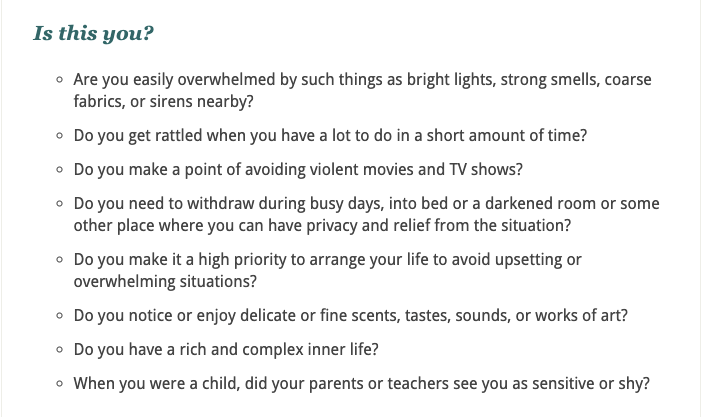
Back in the winter of 2018, I stumbled across a term I hadn’t heard before, but that explained a great deal about the way I experience life: Highly Sensitive Person (HSP). This is a term coined by Dr. Elain Aron, a psychologist, scientist, and researcher, who noticed in herself and subsequently in her studies a natural inclination for about 20% of the population to exhibit heightened sensitivities to sensory stimulation. HSPs have more sensitive central nervous systems, are more easily overwhelmed by sensory input, and tend to take longer to process new information. They have a tell-tale tendency to “stop and check” before entering new situations. Another term for HSP is Sensory-Processing Sensitivity.
Here’s a screenshot from Dr. Aron’s HSP website’s homepage.
I read her book, The Highly Sensitive Person: How to Thrive When the World Overwhelms You, and marveled about how all of the areas I struggled with as a child, and continued to struggle with as an adult, could be fit under this one umbrella term. (I could go into a great deal of detail here about what in particular about my life experience matches an HSP one, but for now, I’m going to stick to chronicling the general timeline leading up to the official recognition of my neurodivergence.)
I began examining my behavior, my experiences of the world, and my past through an HSP lens. A lot of things were making more sense to me, and to an extent, I was able to modify my interactions with the world and other people to be more in line with my comfort zone, which I had been blatantly ignoring or feeling guilty about not ignoring my whole life.
But after a while, I realized something didn’t feel…right. Dr. Aron talked about HSPs as having great gifts and the HSP trait as an advantage. On paper, I agreed, but being an HSP didn’t feel like an advantage to me. It felt like, well, a disability.
This isn’t a word I use lightly. I wrestled with it mentally for a long time, but the more I wrestled the more I felt that, yes, I feel dis-abled (see this fabulous TEDTalk by Autist Jac den Houting in which she says, “I am not disabled by my Autism; I’m disabled by my environment.”) by these traits that (according to Dr. Aron) are supposed to be strengths.
I strongly believe I never would have gotten to this point of understanding if I hadn’t deconstructed the conservative, fundamentalist religious influence, mindset, and worldview I grew up practicing. Some people I know might not like this, might feel off-put, might shut me out because of it, but it’s true, and it’s important. Since about 2016, I’ve been engaged in a long, arduous process of re-examining things I took for granted as truths for my entire life. Part of that has involved learning how to trust my instincts and my lived and inhabited body knowledge. That they aren’t sinful urges to be ignored or temptations to be gutted through. After spending over 20 years ignoring intuition, pushing past my own limitations daily, it’s daunting, trying to reclaim boundaries, self-knowledge, and self-trust. But I was trying. And my lived experience was telling me that HSP wasn’t it. Not all of it. I wasn’t through learning about myself. There was more work to do.
In March 2020, I reached out to a couple of local therapists who claimed specialization in–or at least knowledge of–HSP. I figured maybe I just wasn’t understanding how to work with my HSP traits, that maybe this feeling of dis-ablement could be mitigated by picking up some tips and tricks. Then the pandemic shutdown happened, and I never reconnected with them. There were more important and distracting things going on the in world.
In the summer months, I started to pick up where I had left off. I hadn’t felt comfortable with either of the therapists I’d talked to in March, so I did more googling. I stumbled across this article, which posited that HSP traits in females could really be female Autism. Following that rabbit trail, I found other sources like this YouTube channel run by a British woman who is Autistic. Like me, Sam was diagnosed with Celiac disease, identified as HSP, and finally, sought an assessment for Autism, and found she met the DSM standards to be considered on the spectrum. I found videos like this one in which Autism expert Tony Attwood talks about the characteristics of females with “high-functioning” Autism (commonly known as Asperger’s Syndrome before the update to the DSM-5 removed this label, confusing many and robbing many of an identity they’d come to claim with pride) and of the crises unidentified female Autists go through, including anxiety and depression.
I found this unofficial list of female Autistic traits. I was shocked. I identified with something like 98% of the traits compiled.
I took online quizzes (here and here). With the consistent result: high possibility of neurodivergence and/or Autism.
“You don’t seem Autistic.”
Until August 2020, I would have wholeheartedly agreed. Turns out, the reason I don’t “seem Autistic” has less to do with Autism and my own neurodivergence and more to do with false stereotypes of Autism that are deeply rooted in decades (if not centuries) of sexism and gender discrimination that have affected the very development of the fields of medical science, psychology, and the Diagnostic and Statistical Manual of Mental Disorders (DSM) itself, the bible of psychological “disorders” used to “diagnose” the mental “disorders” we see in the Western world.
There are fundamental differences in how individuals on the Autism spectrum may behave, but until very recently, they have not been recognized. This is due in part to the fact that, when conducting trial studies and tests, psychologists have consistently chosen cis-male subjects. For more on the history of this, and info on neurodivergence in women, I highly recommend Divergent Mind: Thriving in a World that Wasn’t Designed for You by Jenara Nerenberg. This book literally was published in 2020, and would not have been available to me if I had started this research ONE YEAR AGO.
After an intake appointment in which my assessor agreed there was sufficient evidence to proceed, waiting four weeks for my appointment, four hours of testing, two weeks of waiting for my assessor to analyze the data, I learned in a video call that I met criteria for Autism Spectrum Disorder, Level 1 (the lowest level of assistance needed; the DSM-5 goes through Level 3), what would previously have been known as Asperger’s Syndrome, and in a surprise 2-for-1, I also learned I met criteria for ADHD, inattentive type.
Here’s a distinction that’s important: I was not identified as Autistic, ADHD, or neurodivergent by the experts. At age 30, I identified myself, and then sought an expert to officially reinforce what I already knew to be true.
The medical, psychological, and social systems in my life failed me.
This is especially depressing, because as a female, the world had already failed me in so many ways. I was socialized to fly under the radar. I was socialized to “get by” without accommodation, to put others’ needs before my own, and I was smart enough that I could manage. Barely. But the resulting depression and anxiety for constantly struggling to fit into a world where everyone else seemed to fit in easily made life miserable.
I would like to note that my assessor was a lovely person. She was knowledgeable about ASD in women, and delivered the results in a kind, considerate way. At one point, she told me, “There’s nothing wrong with you.” I believe this is true. But I also believe that I am not in the category of what is considered “normal.” She expressed her desire for the day when neurodivergences are understood as a spectrum, rather than disabilities, and I wholeheartedly agree.
ADHD?
I still don’t fully understand the implications of this piece. I haven’t done nearly as much research here. But I do think ASD and ADHD together may explain things that look contradictory, like why I thrive on a schedule, but also have trouble sticking to schedules.
What Now?
As I once again reframe my life experiences through these new lenses, I am heartbroken for the little girl I was, and for the ways my life might have been easier, better, happier. I am also viciously proud of myself for accomplishing things that were desperately hard for me. Singing the lead in a musical. Singing the lead in an opera. Traveling internationally. Graduating with my master’s degree. I didn’t know other people didn’t struggle this much or in the ways I struggled.
My hope is, with this new understanding of how I perceive and interact with the world, I can build a life that allows me to thrive, that makes me happy more often than sad, and that enables me to reach my highest potential.
I also hope I can bring empathy and understanding around the issue of neurodiversity and dis-ability. The experts and Autists I found online were overwhelmingly not-American, and I believe my country is behind on this issue. If you want to talk more with me about this, please reach out. The world is a big, scary, and unsure place. Caring for each other is what makes it beautiful.
*Minutes before publishing this post, I wonder if I’m making the right decision, sharing this information so soon after receiving it myself. I am convinced, though, that staying hidden, masked, and under the radar–the way I’ve been living for my whole life as a neurodivergent person–will not help me or anyone else, and that if I don’t act on the information I’ve received, I might as well not have sought clinical affirmation at all. And, I remind myself, if this makes me feel socially awkward or uncomfortable, that is nothing new. 😉
* This post was edited on January 3, 2021 to remove and reword language including the word and variations of the word “diagnose.” I no longer use the word “diagnose” in relation to my neurodiversity, as it implies an illness or medical condition. Neurodiversity is not an illness. I am not sick.

 Allison Wall