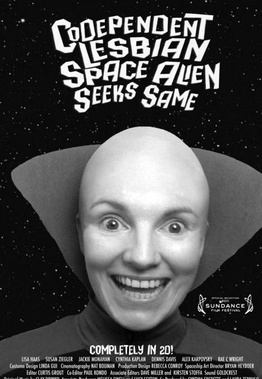
My quests to (1) find authentic sapphic/lesbian things to watch and (2) become a constantly less mainstream, weirder, more specific version of myself converged in the delightful indie film Codependent Lesbian Space Alien Seeks Same (2011, available on Fandango, free with ads).
If the title isn’t enough to lure you in (it certainly hooked me), then please read on.
Clocking in at about 1 hour and 15 minutes, Codependent Lesbian Space Alien Seeks Same (written and directed by Madeleine Olnek) is a delightful juxtaposition of Annie Hall-esque understated humor (complete with therapy scene; may Woody Allen rot in hell) and a parody of the crunchy aesthetics of 1950s pulp sci-fi. In the film, an alien planet is experiencing a dangerous thinning of the ozone layer, which is being exacerbated by big emotions, notably, love. Inhabitants with such big emotions are to be rounded up and sent to Earth, where they will have their hearts broken and then return subdued, depressed, and no longer a threat to the planet.
Meanwhile, Jane (Lisa Haas), an introverted and sweet earthling butch who lives in NYC, struggles to put herself out there. She is approached by Zoinx (Susan Ziegler), one such exiled alien with big feelings, and they hit it off.
In a third story thread, two FBI agents talk to pass the time on a stakeout assignment. Their conversations (and the film’s commentary) range widely, but are sharpest when discussing queerness, lesbians, and heterosexual culture.
I also could read in a fair amount of Autistic commentary, specifically on dating and socializing. I’m not sure this is intentional, and it doesn’t really ever surface as a theme in the film, so big grain of salt here.
The aliens are not un-Autistic in their speech (monotone), movements (uncoordinated; on the stiff side), and understanding (often taking the literal meaning for comedic effect). The ones we see on screen are also the ones with emotions so intense, they’re destroying their home planet—this also rings true to my Autistic experience of emotions. These choices were perhaps meant to show them as different from earthlings. But at one point, Jane, the human girlfriend, acknowledges she’s never really felt belonging on Earth either. This could be referring to lesbians being unwelcome in heteronormative society, but Jane also seems socially shy and awkward on top of being queer, and other earthling lesbians are depicted throughout who don’t seem to share Jane’s struggles.
So might be worth a watch through an Autistic lens, too!
This movie is truly a gem, and I’m glad to report that it was well received at Sundance and garnered many positive reviews in mainstream publications.
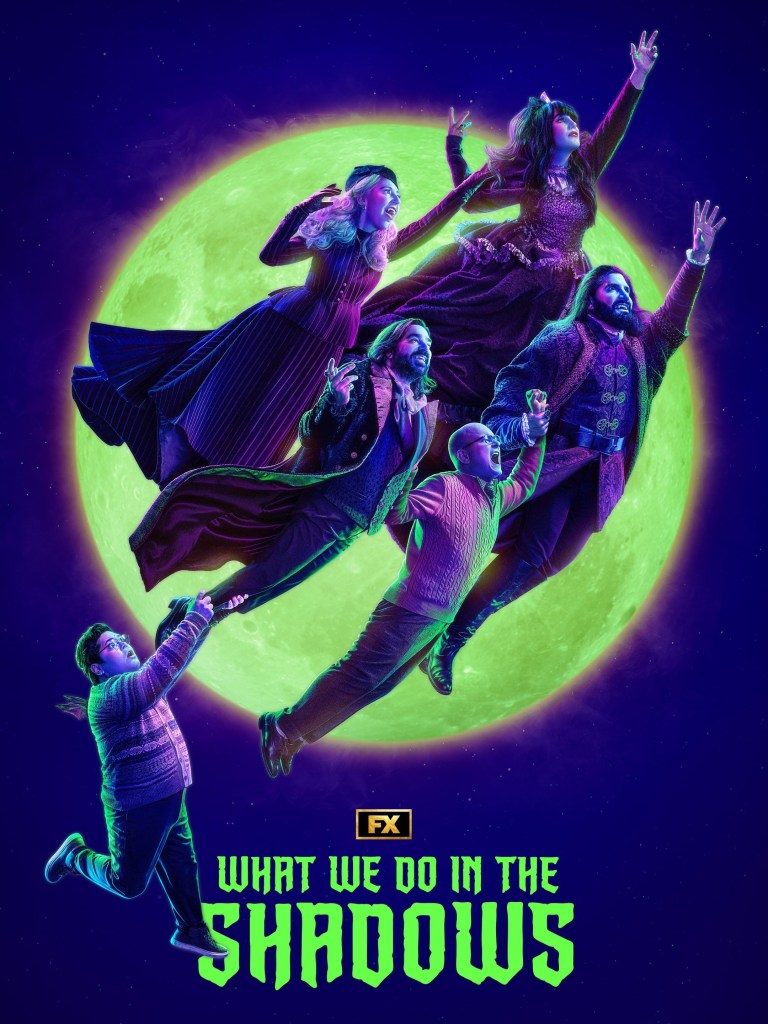
With filming nearing completion on the final season of What We Do in the Shadows (WWDITS)—looks like they’re wrapping on May 3 (see Harvey Guillen’s Instagram post)—I am finally sorting through my thoughts about last season.
For the first four seasons, WWDITS was the funniest sitcom I’d seen in years: quirky, off-beat, queer-inclusive, edgy… Then season 5 dropped.
I’m somewhat hesitant to publish this, as it’s probably not a popular take. But it’s an important opportunity to talk about audience betrayal.
Yeah, betrayal. Dramatic word choice. Intentional word choice.
And yeah, WWDITS is a comedy. But just because it’s intended to make you laugh doesn’t mean its impact isn’t serious.
TLDR: I had a very strong negative reaction to WWDITS season 5.
If you loved season 5, you may not love this essay. Great news! It’s not required reading.
If season 5 turned you off, and you couldn’t quite figure out why…I might have the answer.
***SPOILERS AHEAD***
Made by FX, streaming on Hulu, WWDITS is based loosely on the 2014 film of the same name by New Zealand icons Jemaine Clement and Taika Waititi. It’s a 30-minute situational mockumentary/horror-comedy show about a group of vampires living as roommates in modern-day Staton Island, NY.
Thematically, WWDITS is about outcasts. A lot of its humor is drawn from the clash of ancient, Old-World vampires in modern human society—somewhere they clearly do not belong and are not welcome. This group of vampires also doesn’t seem to fit in with vampire society; they’re the outcasts of the outcast. Guillermo (vampire Nandor’s familiar and the show’s human main character, played by Harvey Guillen) doesn’t fit in with humans or vampires. He longs to be a vampire, but has Van Helsing lineage that makes him preternaturally good at killing vampires. He also comes out as gay in season 4, yet another kind of human outcast (though I hope this will be less so in coming years; the vampires surely didn’t care). Guillermo fights constantly to make a place for himself, to make his voice heard.
I know a lot of neurodivergent (ND) folks who love WWDITS. If I project a little, I theorize part of the reason is that they feel resonance with the outcast theme of the show. ND folks understand outcast themes deeply. We’ve lived them.
As an Autistic fan, I was ultimately disappointed, crushed even, by season 5.
The problem’s center is a supporting character called The Guide (played by Kristen Schaal). Throughout season 5, she desperately wants to be included in the main vampire gang, who consistently ignore and exclude her. Each instance of exclusion appears to be written for laughs: Isn’t her desperation funny? Isn’t she awkward? LOL like we’d be friends with her…
This didn’t sit right with me. But it was always a quick moment, sidelined instantly for the flow of the episode’s plot, so I could ignore it. Until it culminates in the double-episode season finale. To sum up, The Guide turns vindictive, punishing and imprisoning the gang for shutting her out. Trapped in silver cages, they apologize. They tell her they’ll be her friend, and she lets them go. In the credits scene, it’s revealed they are lying to her, making plans to dump her off on another vampire later.
I had a strong reaction to this.
When I have strong reactions to film, books, television, etc., and I voice them, I often hear, “It’s just a show.” “It’s just a story.” I absolutely do not experience it that way.
Studies on Autistic brains have shown structural differences (~25% more dendritic spines, 50% more synapses) that implicate more and more active mirror neurons, which means we can watch something happen and feel it in our own bodies. “Just stories” become embodied, visceral experiences. Other ND brain types also experience heightened emotional empathy and synesthesia that contributes to a more physical involvement.
Stories are extremely important to me, and to a lot of ND people. They’re a way we can achieve a sense of belonging, both with the characters and with other fans. ND people can have a shaky sense of self, so a story can help us understand ourselves and the world around us in new ways. When we find a story that resonates with our lived experience, it means even more; these are rare. We can identify our experience, identify our emotions, learn, and grow.
Stories broadcast messages. They are cultural containers, reflecting and shaping how we think. Who we are.
This is a show about outcasts…who then create their own in-group and cast out someone else. Maybe that would work, if there was any sense of awareness in the script or story that there was a lesson to be learned here. But there’s not.
The vampires in WWDITS aren’t the brightest or the most morally upstanding. I don’t need them to be. But this betrayal of one of the show’s major themes (outcast-ness), and its audience (who relate to being outcast), cuts deep.
A lot of ND folks deal with Rejection Sensitivity Dysphoria (RSD), partly as a result of having tried over and over to fit in and been rejected. We are constantly held to neurotypical standards and fall short. We are fish being compared to birds. Even if we don’t understand our own neurodivergence, neurotypical people can sense it. Even if they don’t know what they’re sensing, they don’t like it or want to associate with it. After a lifetime, rejection, real or perceived, becomes a fight-flight-freeze-fawn threat, and our bodies react accordingly.
Seeing The Guide go through repeated rejection…and then become the villain because of it? I was shocked that this is how WWDITS handled her character. It’s a no for me.
Being left out is only funny if you aren’t the one being left out. It’s only a joke if you’re laughing with the group. The fact that The Guide turns violent/evil is especially troubling. This is the left-out, bullied kid who brings a gun to school. This is the kid, who, when the news anchors tell us they’ve learned they were “Autistic,” everyone nods, as if that explains everything. They understand now.
Is my own RSD triggered by The Guide’s arc? Is it coloring and maybe even fueling the writing of this essay? Hell yes! Of course it is! Rather than invalidating my point, though, it strengthens it. This is the harm that comes of audience betrayal—not just leaving unfulfilled the initial promises of the show, but actively working against them in what feels like a “fuck you” to fans.
Why did the writers choose this? Why not write about inclusion instead of an exclusion that leads to retaliation?
Unfortunately, I suspect all of this goes down just to get Nandor (played by Kayvan Novak) in a position (a cage made of silver) to hear Guillermo confess a secret safely, so Nandor couldn’t physically retaliate. But there are a hundred other ways that could have been achieved, plot wise. That’s the thing about ableism in storytelling that makes me extra angry: It’s lazy. There are so many ways to write Nandor into a silver cage that would avoid this. (I had the same problem with the celebrated Netflix film Don’t Look Up.)
It is so frustratingly careless.
It is possible for modern sitcoms (a genre built on “friend groups” mocking each other for laughs; see Friends, The Big Bang Theory, How I Met Your Mother, etc.) to explore radical inclusion. This is one of the many beauties of shows like Schitts Creek or the hilarious, queer, pirate sitcom/romcom Our Flag Means Death (OFMD), cancelled tragically early after only two seasons. OFMD also carries the theme of the outcast experience (and involves Taika Waititi, interestingly enough), but in contrast to WWDITS, it is intentionally, insistently inclusive. So much so that the toxic, prickly villain from season 1 is transformed to a beloved central character in season 2, singing a sensitive, heartfelt (if anachronistic) rendition of “La Vie en Rose” a la Lady Gaga from A Star is Born. The impact of this on me and thousands (millions?) of other OFMD fans has been healing and transformative—in a comedy-centered space.
WWDITS writers went one step further to twist the knife in the final episode of season 5. They had the opportunity to include another kind of outcast: a character with a vampiric autoimmune disorder. Despite my revulsion at The Guide’s treatment, I got excited, as a chronically ill person, imagining avenues this would open to examine this new kind of outcast-ness…and in season 5’s final moments, they undid it. The character was healed.
The remedy is not inclusion. It’s removal of the disability.
Season 6 will be the show’s last season, and honestly, I’m glad. WWDITS has turned against its own underlying themes, and in the process, turned against the audience it initially attracted. It has lost its identity severely…also evidenced by season 5’s meandering, boring episode plots, which I’m not going to touch on here. It’s not worth it.
A world that felt tailor-made for me turned into one in which I no longer feel welcome or represented. It’s exhausting, to be cut out of a space that had previously felt inclusive. Unfortunately, it’s not a new experience (see: RDS).
If you relate, I’m sorry. We deserve stories where being excluded isn’t funny or inevitable. Where being excluded—a social experience out of our control—doesn’t mean we are villains capable of violence.
I may check in with season 6 to see if they make attempts at redeeming any of this and/or to see how they wrap the show overall. I am curious to see if they’ve been queerbaiting with Nandor/Guillermo this whole time… I’m not holding my breath, though.
One of the magics of the arts is that, from within our temporary, star-material, biological construct, the life force holding our construct together can create something that we hold out to other temporary, star-material, biological constructs, and we say, “This is how it is for me.” And that sharing implies a question: “How is it for you?”
In other (simpler) words, making things allows us to compare our experiences of reality.
I spent the first 30 years of my life masking my Autistic Self without knowing it, and without knowing that most other people didn’t have the same experience of being alive as I did. So, I love to ask people what their inner life is like, how they think, if they can see in color. I think if someone had asked me about those things, I might have understood myself sooner.
Today someone asked me, “How do you know when you’re masking?”
The answer is simultaneously intangible and one of the deepest, most known sensations in my temporary construct’s memory.
When I’m masking, my intellectual existence is at the top of a river. At the bottom of the river is my sense of being in my body, my emotions, my intuition. The ocean, perhaps, is also down there. The water of the river is divided into a series of locks, each walled off by a sluice gate. The boat starts at the top of the river. It enters the first lock, stops, and waits for the sluice gates to move. It moves to the next lock, stops, and waits for the next gate.
When I’m not masking, there is a river, but there are no locks, no gates. The water runs freely, taking the path of least resistance, to the sea. All the water is connected. It flows. It knows itself. It is a river and it moves like a river.
When I am masking, all my conscious awareness lives in the front of my face. I am focusing on the immediate moment. I forget I have arms, legs, a stomach. I forget I have emotions. I black out the temperature of the room, the glare of the lights, the feeling of the collar of my shirt against my neck. I leave my body to inhabit whoever I’m interacting with. I read their mood, their body language, listening with huge intent so I don’t misunderstand their tone of voice or miss a word.
I am an actor, sliding my way through a scene I have rehearsed but never performed in this particular theater, with these particular actors, one that I will probably never perform again exactly like this. Trying to blend in, to pretend I perform this scene every day. That this is all I do. That I, too, am a professional neurotypical human person. That every single word I’m saying, even the small talk, *especially* the small talk, isn’t something I rehearsed in my head the night before, muttering it on the way over to perform this scene with different intonation to see which feels the best in my mouth.
I am a spy behind enemy lines, avoiding detection. I am getting in and out, fast, no casualties.
I am burning out, because this conversation is taking way longer than I thought, and I never did figure out a sure-fire script to end every conversation politely and there are fluorescent lights flickering and a dog barking somewhere and the Glade plug in smells so cheaply floral-adjacent it’s a poison my lungs are refusing to accept.
And when my spoons are gone, I can’t get my eyes to focus on a page or a screen or my cat or the things around me. But thank fucking god because at least I’m home, though my brain is buzzing inside my skull, and if I could just reach in there and pull the buzzers out, I’d be myself again.
When I’m not masking, it’s not like that. It’s effortless, connected. Energy flows in a loop back to me. Water to water. River to sea. That’s how I know.
When I was a kid, I discovered an entire shelf in the library full of fairy tales collected by Andrew Lang and Leonora Blanche Alleyne: The Red Fairy Book, The Blue Fairy Book… There are 25 of these collections, all named after different colors, and while I don’t think my little library had all of them, there were definitely more than five. I worked my way through them all.
As an adult, I am slowly amassing collections of fairy tales on my own bookshelves, including Italian and Icelandic fairy tales. I read through them periodically.
What is it about fairy tales that appeals to me so much?
Maybe this question isn’t that interesting. Fairy tales appeal to a great many people, so many that they’ve been preserved over hundreds of years. But fairy tales are usually condescended to and relegated to the interests of children (as if that somehow makes them sub-par: children are the most discerning and honest and earnest and curious of our human population and should be respected as such). They aren’t considered “great literature.” The formulaic repetition within individual tales, the disconnected plot points, the coincidences and magical twists of fate are often cause for adult eye rolling.
Within the fields of psychology and analysis, fairy tales have found a certain degree of respectability. Specifically, fairy tales can be translated into archetypal images that can help people make sense of their lives, or images that analysts and therapists use to translate the mythic in their clients’ dreams and subconsciouses and provide insight and treatment accordingly.
Fairy tales are containers for the things humans are concerned about, the questions we have, and how we make sense of the world around us.
I have been reading Julie Brown’s book Writers on the Spectrum. In it, Brown makes the case that Autistic artists do have a cultural legacy to inherit. She identifies likely Autistic literary figures like Lewis Carrol and Emily Dickinson, and maps out the commonalities among these writers. Brown’s book does include problematic, deficit-based language in regards to Autism. Brown is not herself Autistic (that I’m aware of or that she discloses). However, the book is significant, and the commonalities she notes are ring true.
Bizarrely enough, Brown’s list of commonalities among Autistic writers includes a preference for and fascination with fairy tales.
Brown’s explanation for this is that Autistic difficulties with executive functioning make it hard for Autistic people to conceive of longer plots with intricate cause and effect. She also theorizes that this may be because Autistic people have difficulties reasoning out others’ intentions, and so the flat, obvious characterization in fairy tales appeals to them; the characters are easy to suss out.
This may be true for many Autistic people. However, one of the things I love about reading fiction is puzzling out out complex character motivation. I love long, complicated plots. I love charting out cause and effect. I think this may be partly because I’ve been studying these things my entire life as an outsider, attempting to figure out neurotypical human behavior. It’s made me very practiced in the kind of analysis Brown thinks that I, as an Autistic person, wouldn’t be able to manage. I’m far better at it than my neurotypical counterparts.
Failing to understand the inner experience of Autistic people leads to oversimplification. Because it appears that we can’t follow the social interactions around us, we must prefer simplicity in our stories. Instead, what’s likely occurring is that because our brains contain more synaptic density, it takes longer for us to process those interactions. So much information is coming at us so quickly, that the subtleties of neurotypical communication get lost.
But Brown is right in that I, as an Autistic person, am drawn to and fascinated by fairy tales.
From an Autistic perspective, then, why is that?
The most significant thing that occurs to me is this.
Fairy tales frequently deal with the theme of being displaced, without a home, or being a stranger in a foreign place. Characters go out to seek their fortune. They go traveling into the woods seeking something. They experience parental abuse and abandonment. By the end, the protagonist is wealthier, happier, and more married, with a settled and permanent sense of belonging and identity (queen/king, bride/groom, rich woman/man, parent, etc.).
Being neurodivergent comes with a lifelong sense of displacement. I haven’t always been consciously aware of this sense of alienness. I think I assumed most people felt the way I did, like an imposter. But I have rarely felt comfortable in environments everyone else appeared to tolerate and even enjoy.
This is a common experience for neurodivergent folks. Some describe it as feeling like an alien in a human suit.
In fairy tales with female protagonists, there is often a theme of misunderstanding. She knows what she must do–take a vow of silence to break the spell over her brothers, for example–but her actions are misconstrued. Her intentions are maligned. She is not able to explain herself, and she is taken advantage of.
This is a deeply Autistic experience.
But in fairy tales, good intentions are rewarded and those who seek to harm are punished. Everything is set right.
The place that should have been home may fail us. We may be misunderstood. But fairy tales assure us that somewhere there are allies and mentors who will help us. Who will understand our intentions. Fairy tales assure us that we will find home, even if we have to build it ourselves.
Check out my bi-monthly-ish newsletter NEURODIVERSION for neurodiverse news, resources, and community!
A neurodivergent friend of mine recently recommended the Netflix series Love on the Spectrum. This is a reality dating show centering autistic, neurodivergent, and disabled adults as they try to find love. There are series set in Australia and the U.S.
I had some reservations with this rec. I’m generally not that interested in romance-reality content. I’m also generally not that interested in how autism is portrayed in mass media, as is evident in previous essays I’ve published here and elsewhere. I was afraid that the series would be demeaning, ableist, generally cringe-inducing, or otherwise frustrating.
I started the U.S. series (released May 2022) and finished it in less than 24 hours. And I have thoughts.
Autistic / Disability Representation
Rather than casting the show with stereotypical presentations of autism (read: what a neurotypical audience might expect to see a la Rain Man), Love on the Spectrum seems to have purposely chosen people with a wide range of support needs, communication styles, and so forth, what the scientific community might call a wide range of “functioning.” As someone who has been told that I don’t “seem autistic,” I appreciated this full representation of autism. I definitely saw myself represented in the cast.
Regardless of support needs, autistic and disabled people are treated with respect as consenting adults. This gives them the freedom (that they have innately but which is not always allowed to them by mainstream/abled society) to want and to pursue romantic and sexual relationships. They are not infantilized. If they make decisions that seem strange, the people in their lives and the show runners may ask clarifying questions, but they are never told that they are wrong or are making decisions that are illogical. Their wishes are respected. They are adults engaging in adult relationships.
Autistic individuals are portrayed with a high degree of empathy. We see them moving with confidence in their environments, running their own businesses, attending Ren Faires and conventions, and interacting with loving friends and families. We also see them discussing their experiences in the larger neurotypical world (like Ariel in The Little Mermaid, feeling out of place, losing the ability to talk) and we see them bravely working through the anxiety-inducing ins and outs of exploring new relationships.
In general, a neurodiverse philosophy seems to be in place; whenever autism is described, it is usually identified as a difference in brain function, though there are references made to disability, and at least one parent cried when talking about receiving a diagnosis for her child, which felt a bit like mourning the child you wanted rather than celebrating the child you have. However, that emotion faded to the background as the series progressed.
There are moments when I was unsure whether an autistic person was meant to be laughed at for their idiosyncrasies, but these were few and far between. I fell in love with each of the show’s cast members–hard. They are sweet, kind people who respect boundaries and personhood: asking permission before shaking hands, checking in to see if others around them are feeling okay, hypersensitive to never hurt anyone’s feelings. The storytelling of the show has the audience rooting for good connections and positive social experiences. I was so hopeful for each blind date, so elated when pairs hit it off, and crushed when things didn’t go well.
Granted, as a neurodivergent (autistic and ADHD) person, I may be watching the show entirely differently than a neurotypical audience member. Love on the Spectrum doesn’t seem to be made for an autistic audience (it would be perhaps bad marketing to do so, since the target viewer pool would be smaller), but neither does it exclude that audience by offending it, at least as far as I’m concerned. I can’t speak for all autistic and disabled people, of course.
Overall, I think Love on the Spectrum does a ton of fantastic work bringing autistic and disabled people into public awareness as individuals with autonomy and educating about the vast spectrum of what autistic and disabled people look like, want, and feel.
Gender Roles
Love on the Spectrum U.S. submits to traditional gender roles. Dating means a man and a woman go out for dinner or drinks. Men bring flowers. Men initiate payment for the dinner and drinks. Men broach the subject of a next date. There’s nothing wrong with this on its face. I imagine a lot of viewers might not even notice or care. However, this isn’t a complete representation of the autistic and disabled communities.
There is a higher percentage of LGBTQIA+ folks who are autistic than in the general neurotypical population. It would have been nice to see that reflected in Love on the Spectrum U.S.’s casting. I believe the Australian series is more inclusive in this respect.
There was at least one individual (maybe two) that I suspected might not be attracted to the opposite sex, based on their interview comments and how their dates went. I’m not going to speculate on anybody’s sexual orientation so I’m not going to name them, but it seemed to me a good example of how autistic people with rigid/structured thought processes try unsuccessfully to fit themselves into the wrong boxes, and then wonder why things aren’t working out. With a fuller example of what options are available, I wonder if those individuals might have an easier time figuring out what they want and then finding intimacy.
Dating “Norms”
I find it awkward that the show forces neurodivergent individuals into neurotypical concepts of dating and relationship building. For example, many of the first or blind dates occur at busy restaurants. An environment like that, for me, is not conducive for getting to know a stranger. I’m distracted by the hustle and bustle, I’m nervous in a setting that is new to me, hypervigilant, and I imagine with all of that, on top of meeting a stranger, in front of cameras and a film crew, that most participants were masking within an inch of their lives and experiencing high degrees of anxiety. How can anyone know if they’re genuinely connecting to another person if both they and the other person are in that state?
Would it have been difficult to tailor the dating environments more to what the participants were comfortable with? Is the “fish out of water” experience necessary to make good reality show content?
In general, participants went along with the pre-set scenarios with bravado. They have lots of practice with this, since the neurotypical world almost never makes room for alternate preferences. But it would be refreshing to see first dates that help rather than interfere with the larger goal, as opposed to dates that follow the neurotypical concept of What Dates Look Like.
Common Interests
As I have realized in my own life, having common interests with a person I am trying to build a relationship with is crucial. The participants in Love on the Spectrum emphasized this too. Without common interests, autistic people had almost zero chance of hitting it off. But if common interests were present, the couple were eventually able to merge even the interests that weren’t in common to include each other.
A great example of this was with Abbey and David. On their first date, they walked around a zoo. Each person talked about the animals and movies they liked, but they didn’t really exchange ideas. It felt like watching two people in bubbles float next to each other. It was hard to tell if they were hearing each other or taking one another in. But by their third date, they were exchanging information. There was no monologuing. They were creating new ideas together, applying something the other person said to a new situation to make a joke that they both laughed at. Their bubbles had merged. They were creating a shared reality: a relationship.
And I’m back to representation.
Autistic people often have what is described as rigid thinking. I touched on this a bit in terms of attraction and orientation, but it applies across the board to all life experiences. It can be difficult for some neurodivergent folks to conceptualize things they have never seen examples of. They don’t know what the options are if they haven’t been presented to them. This can be paralyzing and can severely limit what autistic people do. They can’t imagine themselves in a relationship, moving, getting married, etc. etc. etc., so they are unable to do those things at all, or even take steps toward them.
Watching autistic relationship building was revelatory to me in helping me think through previous relationships and the ways in which I interact with people. Too, I had so many mini-breakthroughs about myself and my neurodivergent friends just seeing autistic people talk and think and process and move in the world. Little things I’ve experienced and logged away on a subconscious level broke through to my conscious awareness by seeing these examples on screen. This allows me to analyze and understand my experiences, rather than blindly intuit my way forward.
This is huge. This is why representation matters. And this is why I think autistic people need to be watching this show.
Overall
I find Love on the Spectrum to be a delight. Yes, there are problem areas, but in my estimation, the positives outweigh the negatives. Autistic people are shown as empathetic, humanized individuals with a variety of abilities and skills, with agency, as adults, in romantic situations. The format of the show is recognizable and comfortable as reality television without feeling overblown and exploitative.
Honestly, as far as romance-based reality TV goes, Love on the Spectrum is a breath of fresh air. I fully intend to watch all other series and versions of this show.
I am also interested to see what other people think! Do you disagree? Agree? Did I miss something? I love respectful discourse and debate about pop-culture media, so please drop a comment and let’s talk!
Check out my bi-monthly-ish newsletter NEURODIVERSION for more neurodiverse news, resources, content, and community!
These are my own opinions and reflections. I know others may and do feel differently and at no point do I judge, belittle, or put down anyone for how they deal with or think about the subject of this post. I may also feel differently in the future. This is all a learning process.
I was diagnosed with autism and inattentive ADHD in November 2020.
Almost immediately after I found this out, I realized I hated saying that sentence, especially the “diagnosed with” part. I am still getting used to, “I am autistic,” but through those words, I feel a sense of pride and relief: they help me know myself more fully. “Diagnosed with” never sat well, and as time goes on, it’s sitting worse and worse and worse.
Why?
Let’s deal first with the word diagnose. What does it imply? Disease. Ill health. Failing organs. Shortened lifespan. And, sometimes, an accompanying cure.
I know this word has been important in the history of autism and our understanding of it. Pathologizing neurodiversity as a disease has been historically necessary in order to get autistic children legal access to any form of education, let alone accommodation once actually in the classroom, and to get autistic adults accommodations in the workplace. But it’s wildly stigmatizing.
Pathologizing neurodiversity has pathologized entire ways of being. For many neurodiverse (ND) people, this has led to damaging and traumatic experiences, as neurotypical (NT) people around them sought to cure them out of behaviors, traits, and tendencies that did not fit within arbitrarily and culturally defined categories of what they deemed “socially acceptable.”
What NDs need is not diagnosis and cure, but empathy and acceptance from their NT peers. The anxiety and depression most NDs (including me) struggle with is in large part due to our attempts to interact with a society that does not understand us or our brains, and seems to have no use for us or interest in us.
Societal education is needed, across the board, in workplaces and schools and religious institutions and grocery stores and banks and in public transit… This should be simple. But there is no switch to flip for a better society. And, unfortunately, there are NT people out there (like the musician Sia) who are willing to benefit financially from perpetuating stereotypical and harmful interpretations of autism for mainstream audiences, many of whom may not have other interactions with autism.
But, as the wonderfully empathetic Mr. Rogers once said, there are always helpers. There are many amazing advocates and ND people hard at work right now with the goal of societal education in mind, some of whom have been working since before I was born. As a writer, choosing my language is one way to contribute, a way to fight back against pathologization, and to fight for a more enlightened, caring, and openly diverse population.
Now for the word with.
With is a preposition, a part of speech that expresses relation between a noun and something else in the clause. As I tell the students I tutor, prepositions are hard. I’d also add that they’re important.
For example:
There is nothing wrong with me.
But there is something different about me.
About me is identity. “Let me tell you about her,” implies that the speaker is going to describe the person in question. With me is in addition to, alongside, accompanying. Autism, ADHD–neurodiversity–is not accompanying me, as cancer cells do someone with Leukemia. Neurodiversity is me. It doesn’t impede my functionality; it describes it.
In the right setting, my neurodiversity is an asset. In the wrong setting, it’s not.
Which brings up another, darker layer to all of this though, involving internalized ableism.
For those who might not have come across the term, Merriam-Webster defines ableism as “discrimination or prejudice against individuals with disabilities.” It’s essentially the incorrect concept that people with disabilities are lesser.
When ableism is internalized, just like when racism is internalized, ableist thought becomes part of the structure of our minds. We can act in ableist ways without realizing what we’re doing. Even if that means we’re being ableist toward ourselves.
There is a possibility that I may have an aversion to the phrase “diagnosed with” because I have unresolved internalized ableism, which I am experiencing here as resistance to applying that phrase to myself.
But I also don’t feel totally comfortable with the term “disabled.” Again, this could be internalized ableism telling me “disabilities = bad” and so I try to distance myself. The facts of the matter are: I have to approach tasks and situations differently than NT people might. I have difficulties with social interactions and in relationships. I have a low energy level and I have trouble regulating my emotions. I struggle with anxiety and depression as a result of being in a culture that doesn’t seem to understand or value me, or what I need to thrive. The very reason I sought assessment in the first place was because I was feeling disabled.
I clearly still have a lot of thinking and processing and learning and growing to do around all of this. But I wanted to write this essay anyway, to capture the evolution of my thoughts, to be transparent, to show what it looks like to realize you’re autistic in an anti-autistic society, and, selfishly, to help myself process by writing and thinking about all of this.
Words matter. The way we talk about our differences matters.
For now, this is how I’m choosing to talk about mine. Rather than saying, “I was diagnosed with autism,” I say,
I’m neurodiverse. For me, that means I’m autistic, ADHD, and HSP.
And, I suppose, if anyone expresses surprise or doubt, I can pull out the old, “I was evaluated and met assessment criteria for” card, but I’d like to do as much as possible to de-stigmatize and de-pathologize a way of being, even if I have to do it one word at a time.
If you have thoughts on this topic, please share in the comments! I’d love to have dialogue with you all about this, whether this is all brand new to you, or if this is something you’ve thought about already. I’m completely open to learning and growing and changing my mind.
Before my first appointment with the clinical psychotherapist who assessed me, I knew I was autistic.
As I talked about in a previous blog post, the education, mental health, and health care systems did not identify me as autistic; I discovered it on my own at age 30, like so many other women whose neurodiverse traits don’t match the stereotypical male presentations.
So if I knew I was autistic, why did I bother to go through all the stress, expense, and time to get an official assessment of Autism Spectrum Disorder in a pdf? (Especially now that I’m 30 and ancient of days?)
Great question.
1. Things weren’t going so great.
There’s a mentality among some that if I’ve made it this far in life without an official recognition of my neurodiversity, that everything must be fine. This is far from the truth.
Yes, I was an “A” student. Yes, I graduated from a master’s program with a 4.0 GPA. Yes, I am employed.
But my life post-structured school environment was at loose ends. The world around me seemed to be getting more and more intrusive as I felt more and more sensitive to all sensory input (the seams of my clothes, ambient noises, foods, interruptions, smells). I had several part-time jobs, but couldn’t afford rent on my own. I had trouble keeping all but a small handful of friends. I was anxious. Periods of depression were coming more often and lasting longer. I wasn’t happy. Everything felt harder for me than it seemed to feel for my peers. I had started to feel disabled.
When I found out about how autism looks in women, I knew I had a potential answer. And I knew I needed help with that answer and all its implications.
If things aren’t going great, it’s always a good idea to seek help. Partly because I’m autistic, though, I prefer to do things on my own, including research. I wanted to go in to a professional for help, with a strong, clear idea of why I needed help.
2. Self validation.
I needed to prove to myself that my assessment of myself was accurate. Self doubt and the need for external validation is a problem for me, probably from years of anxiously and unsuccessfully navigating social and health care systems. I am also extremely empathetic, and it can be difficult for me to tell whether emotions or experiences I’m learning about are mine, or if I’m taking on the emotions and experiences of others. I’m also a bit of a hypochondriac. I was 90% sure I was autistic, but I needed an official’s opinion for the last 10%.
This might not be necessary for everyone. If you’re super confident in your own understanding of yourself, all the better for you! I am more than a little jealous of your self-confidence.
3. Social validation.
I wanted backup if family and friends didn’t believe me. I was very afraid of telling people about my discoveries and hearing, “You don’t seem autistic,” or, “You can’t be autistic because of X.”
Those closest to us can hold a lot of power over us. The denial of autism is a knee-jerk reaction, I think in part because of internalized ableism and the ways autism has been wrongfully stigmatized. But it’s a lot harder for those closest to us to try to explain away our experiences if we have a third party (who also happens to be a licensed professional) backing us up.
4. Recognition and respect from the mental health field.
My experience with the medical and mental health care fields is that, unless there’s an actual, scientific diagnosis, my descriptions of my situation tend to be mislabeled as anxiety and dismissed. A doctor, counselor, or therapist would respect the official documentation of my assessment far more readily than my claim to be autistic without any “proof.” Having a third-party recognition of autism, ADHD, etc., will also help to make the most of future therapist-client interactions.
5. Accommodations.
Just because I’m out of school with no plans to go back (if I EVER write about wanting to get a Ph.D. or another master’s, STOP ME) doesn’t mean there’s no reason to seek assessment. Telling an employer that I need to be accommodated because I think I’m autistic carries less (or maybe no) legal weight than if I have an official stamp from a clinical psychologist.
Neurodiversities can and should be welcomed in school and the work place. That means that individual needs should be met wherever possible so that we can thrive alongside our more neurotypical peers. Advocating for yourself will likely go better overall if an official assessment shows neurodiversity.
6. Bonus knowledge.
My assessment revealed that I also met criteria for Inattentive ADHD. This was a total surprise. I never would have found this out or suspected this on my own–or at least, it would have taken me a while longer. The ways my autistic traits interact with my ADHD traits is a whole thing, and probably, a whole different blog post…
Assessment may reveal things about yourself that you had no idea about, things you weren’t necessarily looking for, but which could help in day-to-day functioning and in deepening self-knowledge.
But in the end…
All of this refers to me and my experience. It is not a recommendation or a suggestion. If you’re on the fence about assessment, there are definitely pros and cons, and you should absolutely do your own research and make the decision that’s best for you. I was lucky enough to have the time to invest, the money to afford it, and connection with an assessor who was aware of the most recent research emerging on women on the spectrum, and, who was kind. Not everyone is so lucky.
This whole journey can be completely overwhelming, and I wish I’d had someone to talk to about it. So, even if we’re total strangers, I am 100% available to listen or to talk you through any part of it. Feel free to reach out to me, either in the comments or by message, even if you’re reading this five years after it’s posted!
The most important takeaway of this entire post is:
Do what you need to do to live the happiest, most fulfilled life possible.