I am so excited to announce the publication of my first novelette, Unbound!
This is the longest work I’ve ever had published, and I am so thrilled it is now live at the amazing Last Syllable.
What’s a ‘novelette’?
For those blessed enough to be unaware of industry slang, a novelette is generally defined as a work of fiction between 7,500 and 17,500 words. Unbound clocks in at about 17,300. It’s on the long end, but not quite long enough to be a novella, which is 17,500 to 40,000 words. Anything 40,000 and up is considered a novel.
So, Unbound is just less than half of a pretty short novel. It’s also divided up into mini chapters, so reading it all in one sitting is not required!
What’s it about?
Unbound follows Nerissa, the granddaughter and heir of Maia, a powerful coven leader. The day Nerissa finally ascends to the coven’s governing Inner Circle, Maia informs them they must travel beyond their forest’s borders to defeat a rogue wizard who endangers the entire world by the way he practices magic: unbound.
Unbound is about family, memory, loss, trauma, and identity. It’s about enmeshment, and the ways power can be stolen through fear. Really, it’s a story about deconstruction. About what happens when you realize the way you were taught to think about the world is actually…wrong.
Having pulled apart and reconstructed my own worldviews several times, I’m fascinated by the psychological processes of deconstruction. In Unbound, two characters undergo the deconstruction process, taking very different paths to get there, for very different reasons.
Trigger warnings?
Trigger warnings do apply. Religion isn’t discussed directly, but it was a huge inspiration, so those with religious trauma or who find the social dynamics present in high-control groups triggering may want to skip this one. Trigger warnings also apply for abuse in general, though most of it is referred to or takes place off page.
Warm fuzzies
One last thing. Last Syllable is a literary journal that specifically publishes long-form works, and it’s run by students getting their M.A.s in Writing. I feel lots of warm happy feelings about this, thinking about my own time in grad school studying writing. It was so formative for me, and I love that I (very indirectly) participated in someone else’s education experience. I’m so grateful to the student editor team that picked Unbound for publication!
I am incredibly proud of this story. I hope you take the time to check it out.
And, hey, if it isn’t your thing, maybe the next one will be.
Stories help us discover who we are, what is possible in our lives, and what we should strive for. They are crucial containers of inspiration and wisdom. I believe deeply in the power of story. Unfortunately, that power cuts both ways. Stories can also obscure who we are, create confusion, and impart a profound sense of lost-ness.
The dominant storytelling structure in Western tradition is the Hero’s Journey. Joseph Campbell coined this term in his book, Hero of a Thousand Faces, in which he demonstrates each of the stages by weaving together myths, fables, religious writings, and etc. from various cultures.
One of Campbell’s students, Maureen Murdock, asked him what the heroine’s journey was. His response was something to the effect of: women don’t need to take a journey. Their goal is to realize they are already the destination–implying that women exist to be a destination point, presumably for men.
Vastly unsatisfied with this answer, Murdock wrote her own book, based on her years of experience working in therapy settings with clients as well as drawing from ancient mythology. The Heroine’s Journey: Women’s Quest for Wholeness is Murdock’s answer to Campbell, which points out how patriarchal society forces women to dismember ourselves to survive.
From The Heroine’s Journey, by Maureen Murdock, as published in the Encyclopedia of Psychology and Religion edited by David A. Leeming, 2016.
I come back to this concept of dismemberment.
I’ve read The Heroine’s Journey at least five times (I can tell by the different-colored inks and penciled notes), and each time I’ve been in a different stage of self-exploration. The first, on the brink of stepping out of the cult mindset I grew up in. The second, in the violent aftermath of religious deconstruction. The third, after realizing I am Autistic. The fourth, after I came to understand my sexuality. Each stage was a deepening. I was doing what the book described: I was descending into the dark depths of my Self. I was calling to the parts of me I had abandoned to survive. And they answered.
The Hero’s Journey is sexist, and, essentially, ableist. The concept of going out into the world implies the ability to go out. It implies the stamina and fortitude to conquer. To slay (not that kind of slay–though one could argue that competing on Drag Race would be the ultimate slay-slay) and to return home victorious.
(True, the Hero’s Journey doesn’t have to be a literal journey to a physical location. The stories Campbell uses to illustrate the stages involve male figures performing outstanding acts in a patriarchal world, and these can be read as metaphors. Even in modern stories, though, the Hero’s Journey is generally depicted as an external movement toward a concrete goal.)
A crucial moment in discovering my Autistic Self was when I realized I was coming up against invisible barriers. The older I got, the more I found myself unable to participate in the wider world. Overwhelmed, exhausted, sometimes by nothing “more threatening” than the feeling of humidity on my skin, or an awkward social encounter with a stranger. I felt disabled. The life patterns of my peers were inaccessible, somehow. I could not understand how to get to where I was “supposed” to be.
That’s the point. The Hero’s Journey doesn’t work for me. It isn’t for me. A woman under patriarchy, a disabled Autist with trauma under ableism, a queer person under heterosexuality… None of my recovered, true Self is compatible. But I’ve spent the majority of my life assuming that this story is for me. The stories I read, by and large, were Hero’s Journeys. As a hyper-empathetic person, I can put myself into anyone’s point of view. Anyone’s story can feel like my story. That doesn’t mean it is.
It took me reading books by Autistic writers to understand just how much of my Self I was ignoring in order to relate to the vast majority of the books I have read in my life. To realize how much my Self really wasn’t represented in story. And that’s to say nothing about the other marginalized parts of my Self.
Maybe, somewhere, there is an archetypal rhythm of external living for me. Maybe it was buried thousands of years ago with the aggressive domination of patriarchy and the loss of the old ways. Maybe I’ll find it by doing it. Then again, I’ve always gravitated more toward my internal life than my external one.
The Heroine’s Journey, the journey inward, is not easy, but it is so rich. It rejects completion, domination, acquisition in favor of rest, healing, regaining wholeness. Murdock says we repeat the Heroine’s Journey over and over. A holy spiral, ever deepening. We meet with the moist, life-giving Earth Mother. We meet the parts we abandoned. We welcome them back. We integrate. We become more whole. More able to travel deeper.
I always thought that healing (physically, mentally, emotionally) was needed so one could get back to something else. I am beginning to suspect that there is no something else to get back to. That maybe healing and deepening my Self is not a bridge to some other thing. It is the Thing.
I am beginning to feel my way through a story that is for me. I am beginning to believe that a life spent not in outward pursuit of success or fame, but in quietness, creating, thinking, smelling the spring air, watching birds, gently unwrapping the infinite complexities of one’s Self–that this also is a worthy pursuit. That this also can be Enough.
I love dystopian and post-apocalyptic stories. Sure, they might be based on pretty awful events (nuclear war, absolute dictatorships, inhuman scientific advancements, etc.) played out to an extreme, but for me, that’s where the interest lies. We’re 99.999% sure we’ll never have to try to survive a zombie apocalypse, so it’s fascinating as hell to watch other humans try.
Dystopian and post-apocalyptic fiction is a kind of nihilist, negative escapism in which the reader gets to imagine how the world works at its worst.
But where do these genres stand when the external world starts to look more dystopian and post-apocalyptic than the stories themselves?
This question has been whirring around in my head since early March, when COVID-19 hit my country. Schools shut down. People lost their jobs. Isolation became the new “normal.” The internet (which we already relied on heavily) became many people’s source of income, socialization, and entertainment–their world.
I love reading dystopian and post-apocalyptic stories. I don’t love living in them. None of us do. So it’s not a huge leap to imagine that we’d turn away from these genres.
However, I firmly believe that a real-life apocalypse, a real-life dystopia, will have no negative effect on the need readers have for this literature. If anything, their need will become greater.
Here’s why.
1. Catharsis
Trying to survive day to day, to find work, to stretch a dollar, homeschool, or cook with the five-odd ingredients left in the pantry… We don’t have time to truly process the collective trauma we’re experiencing. But the themes of loss that show up over and over in dystopia and post-apocalyptica allow us to access our grief, and give us space to process our own emotions.
2. Hope
I’d argue that, despite the dark clothes these stories wear, that they’re actually some of the most hopeful stories in genre fiction. The entire premise of them is that there IS life after apocalypse, and that life CAN flourish in a world where everything seems wrong. In the worst circumstances imaginable, characters fight to survive, to protect those they love, and they succeed. Modern society ends–but human life goes on. As we contemplate the apparent fragility of the lifestyles and structures we took for granted and mourn an old way of living, these stories can give us hope for a future.
3. History
As a writer of post-apocalyptic fiction, I admit, I might be a little biased. But I’m not making this up. History’s got my back. The world that lived through the real-life apocalypse and dystopia of World War II wrote about it and read about it. In fact, we’re still writing and reading about it, and that time period makes up a massive portion of the historical fiction genre.
4. Meaning-making
Writing and reading–creating and participating in art–are attempts at understanding the human experience. So now, as we attempt to understand this new apocalyptic, dystopian reality, these genres are going to be more crucial than ever.
If you aren’t ready for them in this exact moment, that’s fine. They and their creators will be there, waiting, when you are.
I’m reading the novel 1Q84 by Haruki Murakami (totally recommend, though I’m starting to take issue with 800+ page novels; they’re EXHAUSTING). There’s a character in it who’s an aspiring fiction writer named Tengo. He has a revelation part-way through the book. He realizes he’s never really been passionate about anything. He’s performed well in school and in work because of people’s expectations. But when those expectations are taken away, he drifts. He writes when he can, but none of his work finds real success. This changes when he ghost-writes a fantastical novella. This story itself and the process of re-writing it changes him. For the first time, he feels for the first time a passionate need to tell his own stories.
These days, I feel very much like Tengo, pre-revelation. I either don’t have the right motivation for this fiction-writing work, or I haven’t discovered it yet.
I am starting to believe the reason you start writing is not the same reason that will sustain continuous writing.
Starting a new project is joyous. There are endless options, and the world of my imagination spreads out before me like Willy Wonka’s candy garden, all glittering jewel tones and unlimited possibilities. But as soon as I start writing, I start making decisions. I prune the paradise of options, sometimes haphazardly, and sometimes I kill the best parts without knowing. One day I realize the story isn’t working. Revision is hard work. I know it’s supposed to take a lot of drafts, but I didn’t realize it would be this many.
Beginning a purposeful writing life is also joyous. I am now a Writer. Visions of solitude, tea, coffee, rainy days, and fountain pens dance in my mind. But at some point, the solitude turns lonely. The tea is gone. And the story I’ve poured so much time into is still lying there like a corpse. Twitching now and then, but mostly dead.
In both cases, what got me sat down in the chair, pen in hand, and what prompted me to choose a writer’s life, has run out.
I don’t want to write.
Does that mean I should make myself anyway? Utilize that childhood lesson to always finish what you start? After all, Neil Gaiman said that you only learn from finishing things.
Or does that mean that this novel is one giant dead end, that I’m wasting my time on it, and my sluggishness and lack of love for it is an indication that I should just move on?
I don’t know.
I’ve been listening to Frank Zappa recently. He’s got some amazing views on art, some of which I talked about in a recent post. In order to compose (create art), Zappa says,
Just Follow These Simple Instructions:
Declare your intention to create a “composition.”
Start a piece at some time.
Cause something to happen over a period of time.
End the piece at some time (or keep going, telling the audience it is a “work in progress”).
Get a part-time job so you can continue to do stuff like this.
Ending a piece, finishing it now doesn’t mean you have to be finished forever. Maybe you are. But you can always decide you aren’t finished and start again.
Zappa put out over 60 albums in his lifetime. I wish I had a fraction of his carefree attitude or determination or whatever it was that constantly motivated his art.
But I’m also afraid that what I’m really experiencing is not some deep, metaphysical need for a motivation, but my inherent flakiness and tendency to be easily bored with what I’m doing. Impatience. My own insecurities in my abilities, intelligence, and vocation as a writer. Or some such toxic combination.
So I decided I had reached the end point with my novel. For three weeks I tinkered with side projects (some flash fiction, a piece involving cyborg pirates), and remembered what it felt like to enjoy the work. And then, out of the blue,
AH-HA
I identified an element of my novel that, whenever I try to introduce it, stagnated the story. So I cut it out, backed up, and wrote forward again. I think this may be the right (or at least a better) direction. In any case, writing new material feels exciting again. Whether that has anything to do with the story’s progress has yet to be seen.
So I guess the right time to finish a story is if you put it away and never take it out again. Give yourself permission to declare the composition finished, even if it’s not Done. It may help you to tell yourself, “I’m never touching this garbage heap of a story ever again.” Fine.Work on something else.
If nothing in you or in the world around you calls you back to the story and you forget about it, then let it rest. You ended the piece, so it’s finished.
My novel drew me back in. So I keep writing. It’s a work in progress.
And I have a part-time job, so I can continue to do stuff like this.
Confession: I’ve been dealing with some artistic jealousy lately.
I started watching the Netflix series Chef’s Table, which provides documentary-like looks into the lives and philosophies of the world’s most successful chefs. The culinary arts are fascinating to me. They’re also always in high demand. Because, well, we all have to eat.
Between jobs, I’ve had a lot of time to think about the kind of life I want to inhabit. The chefs I’ve been watching have each chosen very specific lives for themselves that support and challenge their creativity. The heart of New York City. Modena, Italy. The ultra-remote Andes Mountains. Most can afford to do so because of the success and popularity of their art.
I think in words, not flavors. Unfortunately, creative writing isn’t very lucrative. But if I spend energy on a career in which I can support myself, in which I can be considered financially “safe,” pay rent, and eat, I find my life isn’t worth much to me. If I stop writing, I stop living.
So, if you’ll let me, I’ll just climb up here on this soapbox, for myself and for all the other artists out there who need their art to live but can’t live on their art.
Our society should value story just as much as it values food.
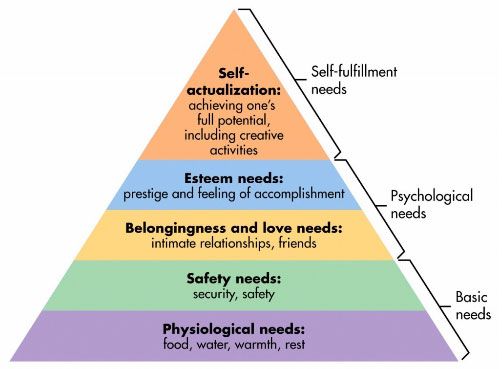
Most of are probably familiar with Maslow’s hierarchy of needs. Here’s a description from “Maslow’s Hierarchy of Needs” by Saul McLeod (2016).
Maslow’s hierarchy of needs is a motivational theory in psychology comprising a five tier model of human needs, often depicted as hierarchical levels within a pyramid.
Maslow stated that people are motivated to achieve certain needs and that some needs take precedence over others. Our most basic need is for physical survival, and this will be the first thing that motivates our behaviour. Once that level is fulfilled the next level up is what motivates us, and so on.
The world you belong to, you reading these words online from an easily accessible electronic device, has a fairly stable base. You’ve achieved the first levels of Maslow’s needs: physiological (food [though maybe not the level of cuisine on Chef’s Table], water, shelter, rest) and safety. Maybe you’re lucky enough to have achieved a sense of social belonging. If you’re REALLY lucky, esteem.
But I doubt any of us have dominated the pinnacle of the pyramid: self-actualization, realizing, becoming, and achieving the best version of yourself.
In this part of our journeys, story is crucial. It can help us navigate toward self-actualization, or keep us from it.
Here’s an example.
All my life, I read (and watched) stories full of characters who inspired me. People like Robin Hood, King Arthur, heroes, who fought for what was right, stood up for those who couldn’t stand up for themselves, faced and defeated evil. In my most formative stories, none of the female characters were appealing. They had boring or minimal roles, were defined by their sexual activity (Maid Marian), or did things I couldn’t get behind, like cheat on King Arthur. Who does that?
As I grew from a girl to a teen to a woman, I devoured story after story and never found a definitive female character I could fully identify with. I didn’t realize how much this had hurt me until I saw the new Wonder Woman movie.
Diana is educated. She is wise. She doesn’t allow herself to be sexualized, ignored, or talked over. She is physically, mentally, emotionally, and morally strong. Secure in her abilities and identity. Not only does she fearlessly go to war against evil, she leads others into the fray. Her strength begets strength. Her power is shared, and doesn’t diminish anyone.
During that foxhole sequence, I experienced what I can only compare to a psychological breakthrough, what one might go through in a productive therapy session. Something deep inside me recognized her. FINALLY, my heart screamed. HERE she is. THIS is who I want to be. Word for word, move for move. This is everything I needed, need, will need. I cried a lot. Every woman I’ve talked to who has seen this movie also cried. Every single woman.
That’s the value of story. We find belonging. Choose what kind of person we want to be. We travel to places we’ve never seen, meet characters we’d never otherwise encounter. The ones we sympathize with and the ones we despise give us a sense of where we belong, who we are, and who we want to be.
When story isn’t valued, when the payday is more important than the art, we get used-up, washed-out books, plays, musicals, and movies that give us the same four or five options. We get brainwashed, almost, into believing this is all life is. This is all we could aspire to. The blushing bride. The lonely old maid. The wicked witch. The stressed mother. Throw a couple of stock characters together, make a few billion dollars. It’s irresponsible at best, reprehensible at worst.
Story is also the means by which we share our experiences. It helps us understand our existence, our identities, and our choices. It is so important. Maybe the most important.
I read a biography of Oscar Wilde once called Built of Books. I believe I can claim that I, too, have grown as a result of the stories I have read, been told, watched. Whether I like it or not. I’m still wrestling to understand the part story has played in my life, and how I want it to function in the rest of it. Why, when someone dismisses my recap of a novel with, “Oh, that’s just a story. It didn’t really happen,” that all of me wants to scream back, “It still matters!”
Writer Tim O’Brien (The Things They Carried) has thought a lot more about this than I have. I’ll leave you with a few quotes from him.
Fiction is the lie that helps us understand the truth.
Stories are for joining the past to the future. Stories are for those late hours in the night when you can’t remember how you got from where you were to where you are. Stories are for eternity, when memory is erased, when there is nothing to remember except the story.
I want you to feel what I felt. I want you to know why story-truth is truer sometimes than happening-truth.
There are two kinds of writers. Those who love writing first drafts, and those who love revising. I love writing first drafts. The first words of a new idea open a hidden door into a new world. Writing the first draft is exploring it, breathing foreign air, seeing new places unfold, and strange characters share their secrets.
I write fast, excited, and as I’m prancing along in a euphoric state (“These are the BEST four paragraphs I’ve ever written! I LOVE the concept of steampunk dirigible pirates! That’s TOTALLY never been done before!” and other delusions) I leave huge knowledge gaps in my wake.
In my last post, I talked about novel writing as a process of sifting and identifying of the unknown. Fiction in any form does not allow anything to be unknown to the writer. What you don’t know always shows on the page.
Insert anecdote.
The first time I submitted a short story to a workshop, my peers discussed my protagonist’s apparent ambivalence to what happened in the story. They couldn’t tell what he wanted or how he felt about events as they happened. From what they read, they couldn’t define his central desire. So they asked me. I didn’t know either. I hadn’t even thought about it.
This discovery proved valuable, and frustrating.I have a consistently difficult time understanding and developing my protagonist’s central desire. Even if I attempt hyper-vigilance as I write, I don’t see into characters’ hearts; I see their actions.
Not knowing a protagonist’s central desire or motivation is a huge vulnerability to any story. Protagonists push plots forward by making decisions based on a central desire. What they want, how far they’ll go to get it, and whether or not they succeed define the scope of the story.
If I let my protagonists make decisions before I understand their desires, I steer them into situations that do not serve their desires, and therefore undermine the plot and the story as a whole. The same thing happens if I lose sight of my protagonist’s central desire or change it partway through the story.
This is part of the reason I’ve had difficulty in plotting to the end of a novel I’m working on. I have tried a couple of different trajectories, but they weren’t right. They didn’t fit the story. I had tried to move forward without taking the time to understand, define, and prioritize my protagonist’s central desire.
Many times I have tried to sit down and verbalize what a character wants and map their actions forward from there. But I’ve found a character’s desire is almost never immediately accessible to me. Maybe a better way to say it is, my characters’ motivations are never complete, or static. They evolve. They clarify in incrementally advancing waves. Each revision, each new, better draft, lets me dig one layer deeper and see one click more in focus. Like at the optometrist’s. Two is better. Three is great. Four is like I’ve got bionic, telescopic eyesight.
And it is my knowledge of character motivation that develops, not the character’s motivation itself. Flannery O’Connor wrote,
You would probably do just as well to get that plot business out of your head and start simply with a character or anything that you can make come alive. … Once you have done a first draft then read it and see what it says and then see how you can bring out better what it says.
I see what my characters do, not what they feel. But in what they do, characters reveal what they want. Their motivation is already on the page in a gesture, an offhand remark. Even when I can’t articulate what a character wants, the character already knows, and is showing me on the page. It’s up to me to notice it, interpret it, in order to “bring out better what it says.”
So, what if we want to understand our characters more fully, but the page doesn’t seem very willing to help? Here’s a few things that I’ve found useful in the past.
Think outside the page. Switch up your process. You may be too trapped inside the page to see what it says. Make lists of things like character desires or objects in a scene. Draw flow charts of timelines, emotional reactions, and potential character choices. The goal is to get your brain thinking about the story from a new angle, one that might let you glimpse what you don’t know.
Take a break. Put the manuscript away, even for a weekend, but the longer the better. Sometimes time is the best thing you can give a story. Your brain will forget the exact sentences and you’ll come back to it fresh and ready to REVISE. (Ugh.)
Get some feedback. Give the manuscript to a trusted friend, ideally another writer, or a very well-read reader. Ask specific questions about your work. Things like, “Are there any places that seem fuzzier than others?” and “What do you think my protagonist’s motivation is?” You can also have them tell you what the story is about so you can gauge their understanding for things you’ve left out.
I’d love to be able to say that I have conquered my writing weakness, that I always know what my protagonists want, but I don’t. I’m working on it. As they say, admitting you have a problem is the first step to recovery.
In my case, “recovery” is that brilliant work I envisioned when I wrote the first draft. The work that will share the thrill of discovery with a reader.



 Allison Wall