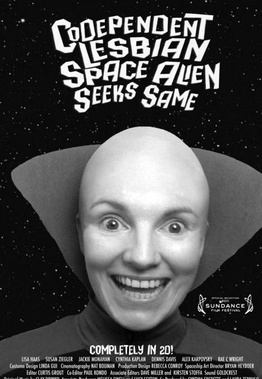
My quests to (1) find authentic sapphic/lesbian things to watch and (2) become a constantly less mainstream, weirder, more specific version of myself converged in the delightful indie film Codependent Lesbian Space Alien Seeks Same (2011, available on Fandango, free with ads).
If the title isn’t enough to lure you in (it certainly hooked me), then please read on.
Clocking in at about 1 hour and 15 minutes, Codependent Lesbian Space Alien Seeks Same (written and directed by Madeleine Olnek) is a delightful juxtaposition of Annie Hall-esque understated humor (complete with therapy scene; may Woody Allen rot in hell) and a parody of the crunchy aesthetics of 1950s pulp sci-fi. In the film, an alien planet is experiencing a dangerous thinning of the ozone layer, which is being exacerbated by big emotions, notably, love. Inhabitants with such big emotions are to be rounded up and sent to Earth, where they will have their hearts broken and then return subdued, depressed, and no longer a threat to the planet.
Meanwhile, Jane (Lisa Haas), an introverted and sweet earthling butch who lives in NYC, struggles to put herself out there. She is approached by Zoinx (Susan Ziegler), one such exiled alien with big feelings, and they hit it off.
In a third story thread, two FBI agents talk to pass the time on a stakeout assignment. Their conversations (and the film’s commentary) range widely, but are sharpest when discussing queerness, lesbians, and heterosexual culture.
I also could read in a fair amount of Autistic commentary, specifically on dating and socializing. I’m not sure this is intentional, and it doesn’t really ever surface as a theme in the film, so big grain of salt here.
The aliens are not un-Autistic in their speech (monotone), movements (uncoordinated; on the stiff side), and understanding (often taking the literal meaning for comedic effect). The ones we see on screen are also the ones with emotions so intense, they’re destroying their home planet—this also rings true to my Autistic experience of emotions. These choices were perhaps meant to show them as different from earthlings. But at one point, Jane, the human girlfriend, acknowledges she’s never really felt belonging on Earth either. This could be referring to lesbians being unwelcome in heteronormative society, but Jane also seems socially shy and awkward on top of being queer, and other earthling lesbians are depicted throughout who don’t seem to share Jane’s struggles.
So might be worth a watch through an Autistic lens, too!
This movie is truly a gem, and I’m glad to report that it was well received at Sundance and garnered many positive reviews in mainstream publications.
Doing everything in my power not to utter the cliche, but it would not be false to say, “I was a poet and was not previously aware of my status as such.”
These two poems belong to a chapbook/collection in development that I hope to publish someday.
Why this shift into poetry? Where did all these poems come from?
These are great questions. I have some answers, but probably not all. The creative process is a spiritual, mysterious experience.
There were things I needed, desperately, to process through writing. I thought maybe I’d write a memoir or a set of personal essays. I even thought it could be a series of blog posts for this platform. But every time I tried, it was like the ouroboros (the snake eating its own tail). I couldn’t find a starting point. The material wouldn’t let me in. It was like trying to jump onto a merry-go-round already in motion. All of it felt connected in a way that didn’t lend it self to the linearity of voice or prose.
Then, without even meaning to, I put one little piece into a poem. That poem was quickly joined by two, three, five, ten more. It felt like the Muse saw someone was accepting poetry, and She poured them out to me. Writing poetry feels like channeling something (an idea, a strong emotion), and the goal is to present it in its most sublime form.
The collage of a poetry collection also offered the scope I needed while giving me permission to abandon that linear sense of plot or storytelling that would be expected in memoir.
After sharing these poems with some trusted friends and writers, and after a bit of tidying up, I started sending them out. Why not? I had a good rhythm established for submitting fiction. I did have a bit of a learning curve, researching places to send poems, but it wasn’t too difficult.
I started submitting poems January 23, 2024, and had my first acceptance February 10, 2024. The second came on April 1, 2024 (no fooling!), and I have other poems out on submission as we speak.
Receiving positive feedback on poetry felt especially poignant. In fiction, there are shields between the words and the writer: point of view, character, voice, plot, etc. In poetry, no such shield exists. At least, not in the poetry I am writing.
And this is what I’ve been dancing around, if you couldn’t tell: the subject matter I needed to express. These poems hold parts of who I am and my experience that I have not addressed openly, directly. The prospective collection’s title is The Cup and Other Abominations: Queer Deconstruction Poems. In it, there are poems about menstruation and communion, the struggle for belonging, and the liberating power of sexual desire (see also: Poor Things). There are poems that give voice to Biblical women whose words were never recorded. There are poems that reclaim my own strength and goodness from a dogma that taught me helplessness and worthlessness. These are poems about finding life and divinity in my own right-now experience, not offloading it onto some other being or future time.
These poems explore the transformational process of deconstructing from evangelical fundamental Christianity and the queer awakening that was only possible after. Deconstruction, sexuality, and the feminine divine: the most unholy trinity.
Specifically, “Step 1: Clay, Sand, Fire” describes deconstruction as I experienced it in a tactile, sensory way. “The Body of God” yearns to reclaim the female body as Divine, and traces some of the damage, some of the things lost, since the rise of patriarchy over the last millennia.
I am ready to share the parts of myself contained in these poems. I hope they are met with goodwill and celebration.
But as anyone knows who has deconstructed or explored their gender and sexuality and come to non-heteronormative conclusions, there are people who will not be happy for me about this. There are people who remember old versions of me, versions that were so heavily masked they didn’t know themselves. This may not sit well with them.
That’s fine.
I don’t exist to fit in or to placate. The Autistic wiring of my brain and nervous system have made that very clear to me. I exist to experience authentically. I exist to liberate myself from the cobwebs, ropes, and chains of Expectation, and to live, without restriction, as myself.
So this is me, taking up space, as a deconstructed, queer, Autistic person.
There will be two poems this summer, and hopefully more in the future. I hope you read them, and I hope whatever I channeled into them, consciously or un-, reaches you.
And if you’re thinking about writing poetry, watch out! I already have a second collection brewing about reclaiming my Autistic self through the spiritual experience of being in the natural world and feeling the thrill of perfect connection.
Once the poems know where you live, they just keep coming…
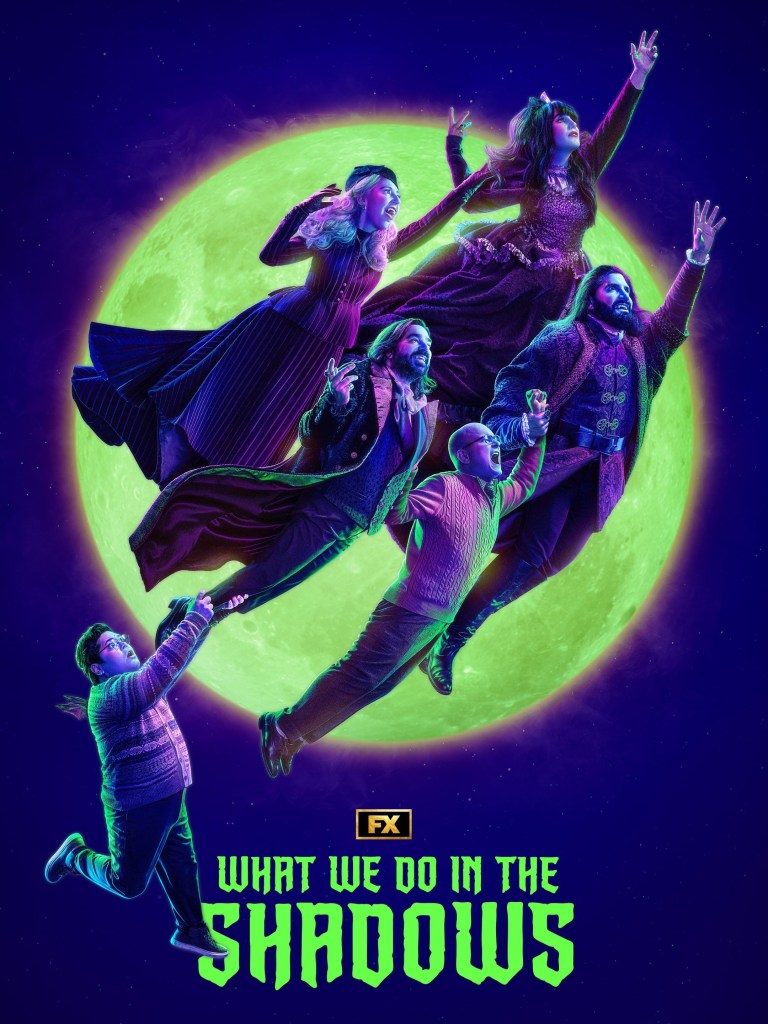
With filming nearing completion on the final season of What We Do in the Shadows (WWDITS)—looks like they’re wrapping on May 3 (see Harvey Guillen’s Instagram post)—I am finally sorting through my thoughts about last season.
For the first four seasons, WWDITS was the funniest sitcom I’d seen in years: quirky, off-beat, queer-inclusive, edgy… Then season 5 dropped.
I’m somewhat hesitant to publish this, as it’s probably not a popular take. But it’s an important opportunity to talk about audience betrayal.
Yeah, betrayal. Dramatic word choice. Intentional word choice.
And yeah, WWDITS is a comedy. But just because it’s intended to make you laugh doesn’t mean its impact isn’t serious.
TLDR: I had a very strong negative reaction to WWDITS season 5.
If you loved season 5, you may not love this essay. Great news! It’s not required reading.
If season 5 turned you off, and you couldn’t quite figure out why…I might have the answer.
***SPOILERS AHEAD***
Made by FX, streaming on Hulu, WWDITS is based loosely on the 2014 film of the same name by New Zealand icons Jemaine Clement and Taika Waititi. It’s a 30-minute situational mockumentary/horror-comedy show about a group of vampires living as roommates in modern-day Staton Island, NY.
Thematically, WWDITS is about outcasts. A lot of its humor is drawn from the clash of ancient, Old-World vampires in modern human society—somewhere they clearly do not belong and are not welcome. This group of vampires also doesn’t seem to fit in with vampire society; they’re the outcasts of the outcast. Guillermo (vampire Nandor’s familiar and the show’s human main character, played by Harvey Guillen) doesn’t fit in with humans or vampires. He longs to be a vampire, but has Van Helsing lineage that makes him preternaturally good at killing vampires. He also comes out as gay in season 4, yet another kind of human outcast (though I hope this will be less so in coming years; the vampires surely didn’t care). Guillermo fights constantly to make a place for himself, to make his voice heard.
I know a lot of neurodivergent (ND) folks who love WWDITS. If I project a little, I theorize part of the reason is that they feel resonance with the outcast theme of the show. ND folks understand outcast themes deeply. We’ve lived them.
As an Autistic fan, I was ultimately disappointed, crushed even, by season 5.
The problem’s center is a supporting character called The Guide (played by Kristen Schaal). Throughout season 5, she desperately wants to be included in the main vampire gang, who consistently ignore and exclude her. Each instance of exclusion appears to be written for laughs: Isn’t her desperation funny? Isn’t she awkward? LOL like we’d be friends with her…
This didn’t sit right with me. But it was always a quick moment, sidelined instantly for the flow of the episode’s plot, so I could ignore it. Until it culminates in the double-episode season finale. To sum up, The Guide turns vindictive, punishing and imprisoning the gang for shutting her out. Trapped in silver cages, they apologize. They tell her they’ll be her friend, and she lets them go. In the credits scene, it’s revealed they are lying to her, making plans to dump her off on another vampire later.
I had a strong reaction to this.
When I have strong reactions to film, books, television, etc., and I voice them, I often hear, “It’s just a show.” “It’s just a story.” I absolutely do not experience it that way.
Studies on Autistic brains have shown structural differences (~25% more dendritic spines, 50% more synapses) that implicate more and more active mirror neurons, which means we can watch something happen and feel it in our own bodies. “Just stories” become embodied, visceral experiences. Other ND brain types also experience heightened emotional empathy and synesthesia that contributes to a more physical involvement.
Stories are extremely important to me, and to a lot of ND people. They’re a way we can achieve a sense of belonging, both with the characters and with other fans. ND people can have a shaky sense of self, so a story can help us understand ourselves and the world around us in new ways. When we find a story that resonates with our lived experience, it means even more; these are rare. We can identify our experience, identify our emotions, learn, and grow.
Stories broadcast messages. They are cultural containers, reflecting and shaping how we think. Who we are.
This is a show about outcasts…who then create their own in-group and cast out someone else. Maybe that would work, if there was any sense of awareness in the script or story that there was a lesson to be learned here. But there’s not.
The vampires in WWDITS aren’t the brightest or the most morally upstanding. I don’t need them to be. But this betrayal of one of the show’s major themes (outcast-ness), and its audience (who relate to being outcast), cuts deep.
A lot of ND folks deal with Rejection Sensitivity Dysphoria (RSD), partly as a result of having tried over and over to fit in and been rejected. We are constantly held to neurotypical standards and fall short. We are fish being compared to birds. Even if we don’t understand our own neurodivergence, neurotypical people can sense it. Even if they don’t know what they’re sensing, they don’t like it or want to associate with it. After a lifetime, rejection, real or perceived, becomes a fight-flight-freeze-fawn threat, and our bodies react accordingly.
Seeing The Guide go through repeated rejection…and then become the villain because of it? I was shocked that this is how WWDITS handled her character. It’s a no for me.
Being left out is only funny if you aren’t the one being left out. It’s only a joke if you’re laughing with the group. The fact that The Guide turns violent/evil is especially troubling. This is the left-out, bullied kid who brings a gun to school. This is the kid, who, when the news anchors tell us they’ve learned they were “Autistic,” everyone nods, as if that explains everything. They understand now.
Is my own RSD triggered by The Guide’s arc? Is it coloring and maybe even fueling the writing of this essay? Hell yes! Of course it is! Rather than invalidating my point, though, it strengthens it. This is the harm that comes of audience betrayal—not just leaving unfulfilled the initial promises of the show, but actively working against them in what feels like a “fuck you” to fans.
Why did the writers choose this? Why not write about inclusion instead of an exclusion that leads to retaliation?
Unfortunately, I suspect all of this goes down just to get Nandor (played by Kayvan Novak) in a position (a cage made of silver) to hear Guillermo confess a secret safely, so Nandor couldn’t physically retaliate. But there are a hundred other ways that could have been achieved, plot wise. That’s the thing about ableism in storytelling that makes me extra angry: It’s lazy. There are so many ways to write Nandor into a silver cage that would avoid this. (I had the same problem with the celebrated Netflix film Don’t Look Up.)
It is so frustratingly careless.
It is possible for modern sitcoms (a genre built on “friend groups” mocking each other for laughs; see Friends, The Big Bang Theory, How I Met Your Mother, etc.) to explore radical inclusion. This is one of the many beauties of shows like Schitts Creek or the hilarious, queer, pirate sitcom/romcom Our Flag Means Death (OFMD), cancelled tragically early after only two seasons. OFMD also carries the theme of the outcast experience (and involves Taika Waititi, interestingly enough), but in contrast to WWDITS, it is intentionally, insistently inclusive. So much so that the toxic, prickly villain from season 1 is transformed to a beloved central character in season 2, singing a sensitive, heartfelt (if anachronistic) rendition of “La Vie en Rose” a la Lady Gaga from A Star is Born. The impact of this on me and thousands (millions?) of other OFMD fans has been healing and transformative—in a comedy-centered space.
WWDITS writers went one step further to twist the knife in the final episode of season 5. They had the opportunity to include another kind of outcast: a character with a vampiric autoimmune disorder. Despite my revulsion at The Guide’s treatment, I got excited, as a chronically ill person, imagining avenues this would open to examine this new kind of outcast-ness…and in season 5’s final moments, they undid it. The character was healed.
The remedy is not inclusion. It’s removal of the disability.
Season 6 will be the show’s last season, and honestly, I’m glad. WWDITS has turned against its own underlying themes, and in the process, turned against the audience it initially attracted. It has lost its identity severely…also evidenced by season 5’s meandering, boring episode plots, which I’m not going to touch on here. It’s not worth it.
A world that felt tailor-made for me turned into one in which I no longer feel welcome or represented. It’s exhausting, to be cut out of a space that had previously felt inclusive. Unfortunately, it’s not a new experience (see: RDS).
If you relate, I’m sorry. We deserve stories where being excluded isn’t funny or inevitable. Where being excluded—a social experience out of our control—doesn’t mean we are villains capable of violence.
I may check in with season 6 to see if they make attempts at redeeming any of this and/or to see how they wrap the show overall. I am curious to see if they’ve been queerbaiting with Nandor/Guillermo this whole time… I’m not holding my breath, though.
Stories help us discover who we are, what is possible in our lives, and what we should strive for. They are crucial containers of inspiration and wisdom. I believe deeply in the power of story. Unfortunately, that power cuts both ways. Stories can also obscure who we are, create confusion, and impart a profound sense of lost-ness.
The dominant storytelling structure in Western tradition is the Hero’s Journey. Joseph Campbell coined this term in his book, Hero of a Thousand Faces, in which he demonstrates each of the stages by weaving together myths, fables, religious writings, and etc. from various cultures.
One of Campbell’s students, Maureen Murdock, asked him what the heroine’s journey was. His response was something to the effect of: women don’t need to take a journey. Their goal is to realize they are already the destination–implying that women exist to be a destination point, presumably for men.
Vastly unsatisfied with this answer, Murdock wrote her own book, based on her years of experience working in therapy settings with clients as well as drawing from ancient mythology. The Heroine’s Journey: Women’s Quest for Wholeness is Murdock’s answer to Campbell, which points out how patriarchal society forces women to dismember ourselves to survive.
From The Heroine’s Journey, by Maureen Murdock, as published in the Encyclopedia of Psychology and Religion edited by David A. Leeming, 2016.
I come back to this concept of dismemberment.
I’ve read The Heroine’s Journey at least five times (I can tell by the different-colored inks and penciled notes), and each time I’ve been in a different stage of self-exploration. The first, on the brink of stepping out of the cult mindset I grew up in. The second, in the violent aftermath of religious deconstruction. The third, after realizing I am Autistic. The fourth, after I came to understand my sexuality. Each stage was a deepening. I was doing what the book described: I was descending into the dark depths of my Self. I was calling to the parts of me I had abandoned to survive. And they answered.
The Hero’s Journey is sexist, and, essentially, ableist. The concept of going out into the world implies the ability to go out. It implies the stamina and fortitude to conquer. To slay (not that kind of slay–though one could argue that competing on Drag Race would be the ultimate slay-slay) and to return home victorious.
(True, the Hero’s Journey doesn’t have to be a literal journey to a physical location. The stories Campbell uses to illustrate the stages involve male figures performing outstanding acts in a patriarchal world, and these can be read as metaphors. Even in modern stories, though, the Hero’s Journey is generally depicted as an external movement toward a concrete goal.)
A crucial moment in discovering my Autistic Self was when I realized I was coming up against invisible barriers. The older I got, the more I found myself unable to participate in the wider world. Overwhelmed, exhausted, sometimes by nothing “more threatening” than the feeling of humidity on my skin, or an awkward social encounter with a stranger. I felt disabled. The life patterns of my peers were inaccessible, somehow. I could not understand how to get to where I was “supposed” to be.
That’s the point. The Hero’s Journey doesn’t work for me. It isn’t for me. A woman under patriarchy, a disabled Autist with trauma under ableism, a queer person under heterosexuality… None of my recovered, true Self is compatible. But I’ve spent the majority of my life assuming that this story is for me. The stories I read, by and large, were Hero’s Journeys. As a hyper-empathetic person, I can put myself into anyone’s point of view. Anyone’s story can feel like my story. That doesn’t mean it is.
It took me reading books by Autistic writers to understand just how much of my Self I was ignoring in order to relate to the vast majority of the books I have read in my life. To realize how much my Self really wasn’t represented in story. And that’s to say nothing about the other marginalized parts of my Self.
Maybe, somewhere, there is an archetypal rhythm of external living for me. Maybe it was buried thousands of years ago with the aggressive domination of patriarchy and the loss of the old ways. Maybe I’ll find it by doing it. Then again, I’ve always gravitated more toward my internal life than my external one.
The Heroine’s Journey, the journey inward, is not easy, but it is so rich. It rejects completion, domination, acquisition in favor of rest, healing, regaining wholeness. Murdock says we repeat the Heroine’s Journey over and over. A holy spiral, ever deepening. We meet with the moist, life-giving Earth Mother. We meet the parts we abandoned. We welcome them back. We integrate. We become more whole. More able to travel deeper.
I always thought that healing (physically, mentally, emotionally) was needed so one could get back to something else. I am beginning to suspect that there is no something else to get back to. That maybe healing and deepening my Self is not a bridge to some other thing. It is the Thing.
I am beginning to feel my way through a story that is for me. I am beginning to believe that a life spent not in outward pursuit of success or fame, but in quietness, creating, thinking, smelling the spring air, watching birds, gently unwrapping the infinite complexities of one’s Self–that this also is a worthy pursuit. That this also can be Enough.