Hi all! Long time, no post! Just dropping you blog-readers a line to let you know that I’ve published a new essay via The Art of Autism. It’s a fierce critique of Netflix’s new satirical film, Don’t Look Up, which features a disturbing portrayal of an autistic-coded villain.
This is very much the kind of content I write on this blog (and if no one had picked it up, it likely would have featured here!), so I think you’ll enjoy it. It’s titled, Don’t Look Up: A Masterclass in Autistic Ableism.
Let me know your thoughts either in the comments here, or over on The Art of Autism’s site!
“Footnotes on a Space Opera” is a humorous first encounter short story, written in a satirical academic voice (complete with footnotes), in which the alien species that lands on Earth is interested in only one thing: opera.
Story Origin
I wrote the first draft of this piece way back in Spring 2015, when I was taking a class on Fantasy at Hamline University for my MFA. I had an assignment to write a short story with an emphasis on voice. As a veteran writing tutor, academic voice was something I knew well. I started writing and the words just flowed.
I remember sitting outside on a patio, relishing the sun after a Minnesota winter, and cackling to myself as I typed. I enjoyed writing it so much, I am extremely proud of the way it turned out after revision, and I am thrilled to be able to share it with you!
Who’s Publishing It?
Here’s where things get even more exciting.
Ready?
Nobody.
I shopped this piece to many markets over years: established SF/F magazines, brand-new zines, anthologies, you name it. I got personal, positive rejections, but no one picked it up.
I have some guesses as to why…
The footnotes can be a formatting challenge, and they’re integral to the story.
It’s an extremely niche mix of genres. Editors maybe thought the Venn diagram overlap of those who enjoy opera and those who enjoy alien science fiction is slim. (This is confusing to me, though, since almost all of the classical musicians and opera buffs I’ve interacted with have been big sci-fi fans.)
With so many submissions to read, any little obstacle can serve as an editor’s reason to say, “No.”
“Footnotes on a Space Opera” is way too funny and I’m way too proud of it for it to sit alone and unread in a Word file on my laptop for the rest of time. So I said “Yes” to myself. I will be publishing this story as an independent author!
Why Now?
The pandemic has been instrumental in helping me come to this decision.
Like many others, I found myself with a lot of time to reflect. I’ve realized that it’s more important to me to share my work and to use it to connect with you than to receive validation from traditional writing gatekeepers.
Pandemic disruptions to the traditional publishing industry (which extend to smaller online markets) have made it difficult to maintain any sense of deadlines, response times, etc.
Lockdown also revealed that I’m autistic and ADHD. People like me (neurodivergent [and female]) have typically needed to find back doors into traditional spaces. Our voices are underrepresented in the mainstream and undervalued by the mainstream gatekeepers. That doesn’t mean we don’t have important (and entertaining!) things to say.
However, it does mean that if I want to see my work in the world, I need to take things into my own hands.
When Can I Read “Footnotes on a Space Opera”?
The official publication date is Monday, September 6! I’ll be back with info on where and how to read it, updates on the process, things I’ve learned, and a cover reveal as that date gets closer.
This will be my first foray into the world of independent (or indie) publishing. That means I’m coordinating every part of the publishing process myself. It’s amazing how many details there are even for a short story.
But I am so excited to share this story with you.
And, if all goes well, I may have even more independent publishing news for you in the future…!
What if I Don’t Like Opera?
Never fear! I’ve had multiple readers who don’t know much (or anything) about opera/classical music, and they laughed right along with my musician readers. You may miss one or two of the more “inside” jokes, but then, you can always ask me (or Google) to help out. Links to my socials are at the bottom and top of the page. I’d love to connect. Especially over opera.
I am thrilled to announce to you beautiful humans that I’m launching a new project! NEURODIVERSION: a monthly newsletter with curated articles, research, and current events that center neurodiverse stories and topics.
Here are my goals for NEURODIVERSION:
1. To provide a shortcut to useful, interesting information neurodivergent readers may find interesting, from a neurodivergent curator.
Navigating the sea of the internet can be extremely overwhelming, especially when ND content is by no means mainstream. I’m going to dive in headfirst and bring up the best, shiniest, most interesting treasure, so you don’t have to!
As I adjusted (and continue to adjust) to an ND paradigm, I find myself doing a ton of internet deep-dive research on neurodiversity in all of its forms. Like many of you, I have a burning desire to share what I learn. And so, rather than ranting about it to my family 24/7 or tweeting about it, I thought I’d package it up and send it to the people who’d be most interested.
2. To provide a potential tool for education and sharing knowledge.
I see this unfolding in two ways.
First, for late-identified neurodivergent adults.
A ton of the information out there (on autism and ADHD in particular) is focused on children and is written for parents of ND children. This is due in no small part to the misconception that these are “children’s disorders” that can be grown out of. I’ll focus on information adults would find interesting, useful, and educational.
For an adult grappling with a recent realization or assessment that is causing a paradigm-identity shift (been there, still doing that), having a regular source of information about neurodiversity in manageable pieces rather than trying to drink from the fire hydrant of the internet all at once may be useful.
Second, for the neurotypical crowd.
I’ve noticed one of the major efforts of ND individuals is education of mainstream neurotypical folks in order to promote inclusive and empathetic practices. I’m not saying this SHOULD fall on our shoulders, but I am passionate about doing any work that will move society toward a future in which neurodiversity is celebrated, invited, and included in ways that respect everyone’s needs.
The information I’ll share will be useful for any NT individual looking to educate themselves about the ND population and our experiences.
Who is this newsletter for?
Anybody who’s interested in learning more about neurodiversity, what’s going on in the world of neurodiversity right now, and ways to support this community.
Anybody who’s interested in finding new friends they can connect with and relate to around the topic of neurodiversity. (Each issue will contain a “Connect” section in which I’ll share the social media accounts of real-life neurodivergents you can connect with in the wild!)
What will it look like?
Here’s a screenshot of the first page of Issue 1. (Note that none of the links will be active in the screenshot; you’ll have to get a copy of NEURODIVERSION in order to get access to the links.)
How do I get a copy?
Issue 1 of NEURODIVERSION is in pdf form below! Click the “Download” button to get your copy.
Each subsequent issue will be delivered directly to the email inboxes of those who sign up to receive it.
You can sign up to receive monthly issues of NEURODIVERSION by entering your email address below. I promise never to use your email for any other purpose than this newsletter, or to give away or to sell your email address to anyone.
Processing…
Success! You're on the list.
Whoops! There was an error and we couldn't process your subscription. Please reload the page and try again.
I am so excited to be starting this new venture, and to learn and grow along with all of you in the wonderful ways of neurodiversity!
One of the most difficult parts in processing my late autism identification and diagnosis (at 30 years old) is dealing with a constantly shifting perspective, specifically in comparing how I function in the world and how non-autistic people function in it.
I spent my whole life assuming my way of being was “normal” or neurotypical, but, as it turns out, neurotypical people exist in the world VERY DIFFERENTLY than I do. Every time I identify, process, and peel back a difference, I find a new one beneath. It’s extremely disorienting.
Here’s the latest paradigm shift I’ve been working through.
In my last post (Where Do Novels Go When No Agent Wants Them?), I wrote about my experience querying my novel ECHOES OF THE OLD WORLD and a couple of potential reasons why no agent made me an offer of representation. After publishing that post, a couple of threads on Twitter popped up that helped me realize I have more to say on this topic. Like, a lot more.
When I wrote and queried my novel, I had no idea I was neurodiverse (autistic, ADHD, HSP). I had no idea that the ways I interact with and perceive the world and read books and watch movies are fundamentally different than the majority of the population. I had never heard the terms neurodiverse/neurodivergent and would not have applied them to myself if I had.
I wrote ECHOES in a first-person point of view. In a lot of ways, my protagonist was a version of myself. We have our differences, but as I wrote her story, I put myself inside her head and looked through her eyes while she was simultaneously in my head…looking through my eyes… So a Russian doll kind of situation.
I knew I was putting myself into her. I didn’t know that meant I was imbuing her with autistic qualities. I didn’t know those qualities were autistic. I didn’t know that neurotypical people didn’t have those qualities or might have trouble relating to them.
Then, I self-identified as autistic, underwent assessment, and received a confirmation diagnosis of Autism Spectrum Disorder. My basic perceptions are fundamentally autistic. Most other people’s basic perceptions are fundamentally not autistic. I’ve lived 30 years without knowing about that difference.
It’s a huge mind fuck.
For example, I recently realized that I don’t think I read fiction the same way a neurotypical person does. This, because I read Madeleine Ryan’s gorgeous book A Room Called Earth, which is written in first-person stream of consciousness from the point of view of an autistic woman. I related to that character. Like, intensely. Like, to the point that I was shocked and emotional at how many times I related to her on each page. (HIGHLY recommend it. Here’s a review of A Room Called Earth I wrote for The Bookends Review.)
Ryan’s book prompted me to ask myself a new series of questions. Do neurotypical people relate to protagonists in fiction as intensely as I related to this autistic character? Have I been not relating to neurotypical fiction in that way? Have I been observing the characters in neurotypical fiction in the same way that I observe neurotypical people in real life? Is there a difference between observing and analyzing someone and understanding and relating to them?
For better or worse, I think the answer to all of these questions is, Yes.
When I queried ECHOES OF THE OLD WORLD, I received a fair amount of responses along the lines of, “didn’t connect to your character/prose as much as I’d hoped” or, “didn’t find myself relating to your protagonist/voice.” I assumed these were form rejection letters. I think for the most part they were. But as soon as I realized I was autistic and remembered these responses, I got worried. Was my fiction fundamentally incomprehensible or inaccessible to neurotypical (the majority of) readers.
Then, I saw a couple of threads on Twitter that confirmed for me that, yes, the neurotypical gatekeepers of traditionally published fiction misunderstand and reject autistic fiction all the time. Readers critique autistic elements within a novel as “not believable” or “not relatable.”
One hypothesis I take away from this is that neurotypical readers need to feel connected with their characters in a way that I, as an autistic reader, don’t.
Don’t get me wrong; relating to the autistic protagonist of A Room Called Earth was a POWERFUL experience. But I don’t have to relate to all characters to that degree to find them interesting enough to follow.
I study people. It’s a survival mechanism. My whole life, my brain has been asking how I need to act to blend in within any given situation. I absolutely do not need to relate to someone to understand them or their motivations. I do not need to feel I would have the exact same emotional reaction as a character in order to understand why they might be reacting that way.
This might be another fundamental difference between autistic and non-autistic readers: autistic readers are far more empathetic and able to analyze and understand characters within narratives. We’ve been practicing empathetic character/person reading our entire lives. We also tend to be more empathetic in general, and can empathize, even with characters with whom we have nothing in common.
I may not have the same needs in terms of character-relatability that neurotypical readers do, because in general, I don’t relate to the majority of the population. I’m used to that. It’s my normal.
So, if that’s true, the question becomes, do I as a neurodiverse writer need to account for that difference in neurotypical reader perception? How would I account for it? Especially if it’s something I can’t really see or identify? I don’t have answers to those questions, only the beginnings of thought processes that may or may not be valuable.
Another realization I’ve had through all of this is that the querying process is harder for me than for my neurotypical peers. In fact, I’d go so far as to say that the querying process is traumatic to neurodiverse people. We tend to be hypersensitive to rejection. We’ve been avoiding it assiduously, consciously or subconsciously, our entire lives. I’ve always known there was something different about me, and because I’ve been consistently misunderstood, I’m sensitive to that. Rejection—especially with the reason of lack of relatability or connection—reads as a misunderstanding and a rejection of my perspective, and even me as a person.
If agents are really using this lack of relatability as a form response, I’d suggest that, in order to make the process less traumatic to neurodiverse people, they use another phrase. A simple no thanks is plenty, if the rejection is going to be a form one anyway.
As I begin to query my second novel, I’ve been experiencing a ton of anxiety. I know going in that my perspective and voice as a neurodiverse writer may not be understood, appreciated, or even wanted. I love this book, and I feel so strongly that it’s enjoyable, valuable, and well written, but going through the querying process feels like the mental equivalent of forcing myself to sit on a chair made of pins. The additional self-revelations that keep happening (will they ever stop??) just add to the emotional difficulty of the process.
This post isn’t a white flag, by any means. Writing is my lifestyle, calling, and passion. I won’t ever stop. But the querying process is starting to feel like an insurmountable obstacle. Just one more of many gates that will never be open to me.
Which is a real shame, because I and so many other neurodiverse writers out there are really, really good at what we do. The publishing industry would benefit from our voices, our dedication, our expertise, our skill, and our stories.
I can’t help but wonder if traditional publishing, and the numerous gatekeepers that maintain it, will ever be ready for us.
I wish I had a happier note to end on, fam, but this is where I’m at today. Take care of yourselves. You and your experiences are of infinite value, no matter who says otherwise.
***
Here are a few links you might use as starting points for further research on the neurodiverse experience and perspective. I didn’t create any of the below content, nor am I being compensated to promote it. I found it useful for myself and so am including it here.
I’m thrilled to be officially querying a brand new manuscript in hope of agent representation! It’s titled THE VIOLET TAMARIND and you can read more about it and see a gorgeous mood board one of my beta readers made for it here.
But Allison (asked almost no one), whatever happened to that post-apocalyptic science-fiction novel you were writing for like five years and pitching and querying to agents?
Ah. Yes. That.
You’re referring to ECHOES OF THE OLD WORLD, the manuscript I started writing in my MFA program (one year for coursework, one year for my thesis) and then continued to work on until I finally (FINALLY) finished it, sent it to beta readers, revised (and revised and revised), and queried.
The short answer is that after one year and over 100 agents queried, no one offered representation. I shelved the book.
Shelved means I’m no longer working on it or attempting to publish it, traditionally or independently.
Definitely unfortunate. Often depressing. Not what I wanted for myself or the story. But I learned a lot through it about my own process, how to write a book, how to NOT write a book, and the publishing industry.
There were a couple of factors that, in retrospect, likely kept agents from offering on ECHOES.
1. I was querying a post-apocalyptic novel during a global pandemic.
Super bad timing. I had already started the querying process in January of 2020. Between the worldwide trauma and aversion to apocalypse since it seemed to be our new reality and the economic recession that hit (and is still hitting) the publishing industry, there was little to no chance of being offered representation with this book at that time.
2. I had unintentionally and unknowingly written an autistic protagonist.
I worked on this book between 2015 and 2019, and I found out that I’m autistic in November 2020. In the throes of processing this new self-knowledge, it dawned on me that my protagonist was also autistic. This amazed me, helped me understand agent rejections, and broke my heart a little. Amazed, because I had so clearly written in autistic traits without meaning to at all. Helped, because I could definitely see how a neurotypical person wouldn’t understand or relate to why my protagonist felt and acted like she did. Broke my heart, because I had so boldly written my own experience of being alive into this character, assuming it was relatable, and she’d been misunderstood. I’d been misunderstood.
Figuring out that my protagonist is autistic is a huge step forward in making the book work. When I lay in bed at night, I get ideas about how to restructure the story so the reader will have no choice but to fall in love with my characters. Ideas about how to rewrite the thing so that autism is included with intention.
But I also have other books in me that want to be written. I’m currently about 70k words into a first draft of a super cool fantasy novel that may end up being a duology. I have another idea for a different fantasy novel. And I could very well end up writing a sequel to THE VIOLET TAMARIND.
I don’t want to move backward, caught in a maelstrom of a book that will never be finished, never be perfect, and never be represented or published, while books that could be are never written into existence.
If there’s a time when it feels like coming back to ECHOES is right, I’ll come running to it with open arms. But for now, it’s onward and (hopefully) upward.
These are my own opinions and reflections. I know others may and do feel differently and at no point do I judge, belittle, or put down anyone for how they deal with or think about the subject of this post. I may also feel differently in the future. This is all a learning process.
I was diagnosed with autism and inattentive ADHD in November 2020.
Almost immediately after I found this out, I realized I hated saying that sentence, especially the “diagnosed with” part. I am still getting used to, “I am autistic,” but through those words, I feel a sense of pride and relief: they help me know myself more fully. “Diagnosed with” never sat well, and as time goes on, it’s sitting worse and worse and worse.
Why?
Let’s deal first with the word diagnose. What does it imply? Disease. Ill health. Failing organs. Shortened lifespan. And, sometimes, an accompanying cure.
I know this word has been important in the history of autism and our understanding of it. Pathologizing neurodiversity as a disease has been historically necessary in order to get autistic children legal access to any form of education, let alone accommodation once actually in the classroom, and to get autistic adults accommodations in the workplace. But it’s wildly stigmatizing.
Pathologizing neurodiversity has pathologized entire ways of being. For many neurodiverse (ND) people, this has led to damaging and traumatic experiences, as neurotypical (NT) people around them sought to cure them out of behaviors, traits, and tendencies that did not fit within arbitrarily and culturally defined categories of what they deemed “socially acceptable.”
What NDs need is not diagnosis and cure, but empathy and acceptance from their NT peers. The anxiety and depression most NDs (including me) struggle with is in large part due to our attempts to interact with a society that does not understand us or our brains, and seems to have no use for us or interest in us.
Societal education is needed, across the board, in workplaces and schools and religious institutions and grocery stores and banks and in public transit… This should be simple. But there is no switch to flip for a better society. And, unfortunately, there are NT people out there (like the musician Sia) who are willing to benefit financially from perpetuating stereotypical and harmful interpretations of autism for mainstream audiences, many of whom may not have other interactions with autism.
But, as the wonderfully empathetic Mr. Rogers once said, there are always helpers. There are many amazing advocates and ND people hard at work right now with the goal of societal education in mind, some of whom have been working since before I was born. As a writer, choosing my language is one way to contribute, a way to fight back against pathologization, and to fight for a more enlightened, caring, and openly diverse population.
Now for the word with.
With is a preposition, a part of speech that expresses relation between a noun and something else in the clause. As I tell the students I tutor, prepositions are hard. I’d also add that they’re important.
For example:
There is nothing wrong with me.
But there is something different about me.
About me is identity. “Let me tell you about her,” implies that the speaker is going to describe the person in question. With me is in addition to, alongside, accompanying. Autism, ADHD–neurodiversity–is not accompanying me, as cancer cells do someone with Leukemia. Neurodiversity is me. It doesn’t impede my functionality; it describes it.
In the right setting, my neurodiversity is an asset. In the wrong setting, it’s not.
Which brings up another, darker layer to all of this though, involving internalized ableism.
For those who might not have come across the term, Merriam-Webster defines ableism as “discrimination or prejudice against individuals with disabilities.” It’s essentially the incorrect concept that people with disabilities are lesser.
When ableism is internalized, just like when racism is internalized, ableist thought becomes part of the structure of our minds. We can act in ableist ways without realizing what we’re doing. Even if that means we’re being ableist toward ourselves.
There is a possibility that I may have an aversion to the phrase “diagnosed with” because I have unresolved internalized ableism, which I am experiencing here as resistance to applying that phrase to myself.
But I also don’t feel totally comfortable with the term “disabled.” Again, this could be internalized ableism telling me “disabilities = bad” and so I try to distance myself. The facts of the matter are: I have to approach tasks and situations differently than NT people might. I have difficulties with social interactions and in relationships. I have a low energy level and I have trouble regulating my emotions. I struggle with anxiety and depression as a result of being in a culture that doesn’t seem to understand or value me, or what I need to thrive. The very reason I sought assessment in the first place was because I was feeling disabled.
I clearly still have a lot of thinking and processing and learning and growing to do around all of this. But I wanted to write this essay anyway, to capture the evolution of my thoughts, to be transparent, to show what it looks like to realize you’re autistic in an anti-autistic society, and, selfishly, to help myself process by writing and thinking about all of this.
Words matter. The way we talk about our differences matters.
For now, this is how I’m choosing to talk about mine. Rather than saying, “I was diagnosed with autism,” I say,
I’m neurodiverse. For me, that means I’m autistic, ADHD, and HSP.
And, I suppose, if anyone expresses surprise or doubt, I can pull out the old, “I was evaluated and met assessment criteria for” card, but I’d like to do as much as possible to de-stigmatize and de-pathologize a way of being, even if I have to do it one word at a time.
If you have thoughts on this topic, please share in the comments! I’d love to have dialogue with you all about this, whether this is all brand new to you, or if this is something you’ve thought about already. I’m completely open to learning and growing and changing my mind.
Before my first appointment with the clinical psychotherapist who assessed me, I knew I was autistic.
As I talked about in a previous blog post, the education, mental health, and health care systems did not identify me as autistic; I discovered it on my own at age 30, like so many other women whose neurodiverse traits don’t match the stereotypical male presentations.
So if I knew I was autistic, why did I bother to go through all the stress, expense, and time to get an official assessment of Autism Spectrum Disorder in a pdf? (Especially now that I’m 30 and ancient of days?)
Great question.
1. Things weren’t going so great.
There’s a mentality among some that if I’ve made it this far in life without an official recognition of my neurodiversity, that everything must be fine. This is far from the truth.
Yes, I was an “A” student. Yes, I graduated from a master’s program with a 4.0 GPA. Yes, I am employed.
But my life post-structured school environment was at loose ends. The world around me seemed to be getting more and more intrusive as I felt more and more sensitive to all sensory input (the seams of my clothes, ambient noises, foods, interruptions, smells). I had several part-time jobs, but couldn’t afford rent on my own. I had trouble keeping all but a small handful of friends. I was anxious. Periods of depression were coming more often and lasting longer. I wasn’t happy. Everything felt harder for me than it seemed to feel for my peers. I had started to feel disabled.
When I found out about how autism looks in women, I knew I had a potential answer. And I knew I needed help with that answer and all its implications.
If things aren’t going great, it’s always a good idea to seek help. Partly because I’m autistic, though, I prefer to do things on my own, including research. I wanted to go in to a professional for help, with a strong, clear idea of why I needed help.
2. Self validation.
I needed to prove to myself that my assessment of myself was accurate. Self doubt and the need for external validation is a problem for me, probably from years of anxiously and unsuccessfully navigating social and health care systems. I am also extremely empathetic, and it can be difficult for me to tell whether emotions or experiences I’m learning about are mine, or if I’m taking on the emotions and experiences of others. I’m also a bit of a hypochondriac. I was 90% sure I was autistic, but I needed an official’s opinion for the last 10%.
This might not be necessary for everyone. If you’re super confident in your own understanding of yourself, all the better for you! I am more than a little jealous of your self-confidence.
3. Social validation.
I wanted backup if family and friends didn’t believe me. I was very afraid of telling people about my discoveries and hearing, “You don’t seem autistic,” or, “You can’t be autistic because of X.”
Those closest to us can hold a lot of power over us. The denial of autism is a knee-jerk reaction, I think in part because of internalized ableism and the ways autism has been wrongfully stigmatized. But it’s a lot harder for those closest to us to try to explain away our experiences if we have a third party (who also happens to be a licensed professional) backing us up.
4. Recognition and respect from the mental health field.
My experience with the medical and mental health care fields is that, unless there’s an actual, scientific diagnosis, my descriptions of my situation tend to be mislabeled as anxiety and dismissed. A doctor, counselor, or therapist would respect the official documentation of my assessment far more readily than my claim to be autistic without any “proof.” Having a third-party recognition of autism, ADHD, etc., will also help to make the most of future therapist-client interactions.
5. Accommodations.
Just because I’m out of school with no plans to go back (if I EVER write about wanting to get a Ph.D. or another master’s, STOP ME) doesn’t mean there’s no reason to seek assessment. Telling an employer that I need to be accommodated because I think I’m autistic carries less (or maybe no) legal weight than if I have an official stamp from a clinical psychologist.
Neurodiversities can and should be welcomed in school and the work place. That means that individual needs should be met wherever possible so that we can thrive alongside our more neurotypical peers. Advocating for yourself will likely go better overall if an official assessment shows neurodiversity.
6. Bonus knowledge.
My assessment revealed that I also met criteria for Inattentive ADHD. This was a total surprise. I never would have found this out or suspected this on my own–or at least, it would have taken me a while longer. The ways my autistic traits interact with my ADHD traits is a whole thing, and probably, a whole different blog post…
Assessment may reveal things about yourself that you had no idea about, things you weren’t necessarily looking for, but which could help in day-to-day functioning and in deepening self-knowledge.
But in the end…
All of this refers to me and my experience. It is not a recommendation or a suggestion. If you’re on the fence about assessment, there are definitely pros and cons, and you should absolutely do your own research and make the decision that’s best for you. I was lucky enough to have the time to invest, the money to afford it, and connection with an assessor who was aware of the most recent research emerging on women on the spectrum, and, who was kind. Not everyone is so lucky.
This whole journey can be completely overwhelming, and I wish I’d had someone to talk to about it. So, even if we’re total strangers, I am 100% available to listen or to talk you through any part of it. Feel free to reach out to me, either in the comments or by message, even if you’re reading this five years after it’s posted!
The most important takeaway of this entire post is:
Do what you need to do to live the happiest, most fulfilled life possible.
My recent autism and ADHD diagnoses have prompted some intense reprocessing of my own memories and lived experiences. It’s like sitting in the chair at the eye doctor, and a new lens is flipped down. Suddenly, everything is clearer. Through the lens of neurodiversity, many things about me and my life make a lot more sense. Understanding myself as neurodiverse is by no means a magical key that’s unlocked all self-knowledge, but my self-knowledge is deepening.
Writing is integral to my life. Which is the same thing as saying I am a writer. It is part of my identity, it is a title I strive to deserve, and it is how I want to spend my time. But what on earth possesses me to sit alone in a room, thinking deep and involved thoughts, and spending hours and hours writing them down? Why do I do that? And why do I feel like I have to?
Writers tend to think about this a lot. They compose Artist’s Statements that deal with their motivations and intentions, if for no other reason than to explain themselves to people who just can’t understand why someone would want to be a writer. I’ve done the same thing. But now, I am looking at this question again, through the lens of my neurodiversity.
This is all new territory. In 2018, I self-identified as an HSP (Highly Sensitive Person), which means my central nervous system processes stimuli more deeply than 80% of the population. In November 2020, I also found out I am Autistic (Asperger’s) and also have Inattentive ADHD. (I wrote a blog post about my journey to assessment and meeting the DSM-5 criteria for these neurodiversities; you can read it here.)
I grew up without this self-knowledge. When I was a kid, I really struggled with school. I did fine as far as grades went. I taught myself to read before kindergarten, and the work itself was easy… But everything related to the logistics of the school day and social interaction was overwhelming. Making friends was confusing, the school day was exhausting, and the thought of going to school often left me with anxiety. I found participating in the world to be very difficult, if not impossible. I didn’t know why. I didn’t know how to express this. And–worst of all–no one else seemed to feel the same way.
The greatest conflicts and unhappinesses in my childhood revolved around school and social situations. The greatest happinesses came from reading. In books, and fiction in particular, I found a safe way to explore and experience a sense of belonging. A way that didn’t overwhelm or exhaust me. A way that allowed me to dissolve into strange new worlds and forget about the stresses of the day.
I read immensely and voraciously. I took home stacks of books from the library too tall to carry. I read for hours alone in my bedroom after school, coming out in a daze for dinner, and rushing right back to my book to read all night. I always had a book with me at school, too, and when I inevitably finished my desk work before my classmates, out it came.
I realize now that I was likely learning about people. In books, I could learn about the way people interact, how they live their lives, people’s motivations, how wanting certain things made them act, what the “rules” of given situations were, how friends acted together, and so forth. Then, if I found myself in a similar situation, I had an idea of what might happen, a sort of pre-uploaded guidebook to the situation. I was gathering and cataloging human social scenarios.
It’s funny. I have a vivid and active imagination. I can create entire worlds on the page. But in my own life, it’s very difficult for me to imagine an outcome or an option that I haven’t seen or experienced before. Books likely helped me expand my understanding of the world around me and its possibilities.
Books spoke to me. I wanted to speak back. So, writing followed naturally as a way I could express myself within and contribute to the literary worlds from which I gained so much.
Story is the structure through which I understand the experience of living. The creative discipline of writing is the action through which I process my own experiences and gain understanding. I can try out scenarios, watch what happens if my characters want certain things, and deal with the frustrations and joys of living in the laboratory of the paragraph.
Writing also fits the kind of life I want to live: a quiet one, maybe even a solitary one, or at least, one with space to sit alone and think.
I think all forms of art have to do with finding connection. Art begins with a person creating, using their experience and paint or ink or the lines of their own body. When they put that piece of art out there, they’re declaring their experience, but they’re also asking a question: “Does anyone else think this too? Do you connect with me?” Every piece of art is message in a bottle cast out into the infinite sea of humanity, a question, an invitation, a potential point of connection.
Being autistic has impacted me most in social interaction and participation. So maybe in the end, I’m writing as a means to connect with people. I’m throwing out my little bottles, hoping I’m not alone up here on my bottle-throwing rock, and hoping I can help someone else feel less alone.
Even after hitting “Publish” on this post, I still don’t know how I feel about the title statement. How it’s worded, I mean. The ideas it represents are absolutely true.
On November 9, 2020, I was assessed as having met criteria for Autism Spectrum Disorder (ASD) and attention-deficit/hyperactivity disorder (ADHD). In other words (and maybe words that I prefer), I’m neurodivergent.
I know this may feel out of the blue to some people. It is to me too, in a way, but in another way, it’s an “of course” lightbulb moment, a flashpoint, where all the experiences of my life have come together to make sense.
So I wanted to have a record of what led to this point in my life to share with you all. I am far more articulate in writing than I am in person, and with the ongoing COVID-19 risk to social gatherings (and my own inclination to spend most of my time alone), I thought this would be the most efficient way to let you all know what’s been going on in my life related to my own neurodivergence.
The Highly Sensitive Person / Sensory Processing Sensitivity
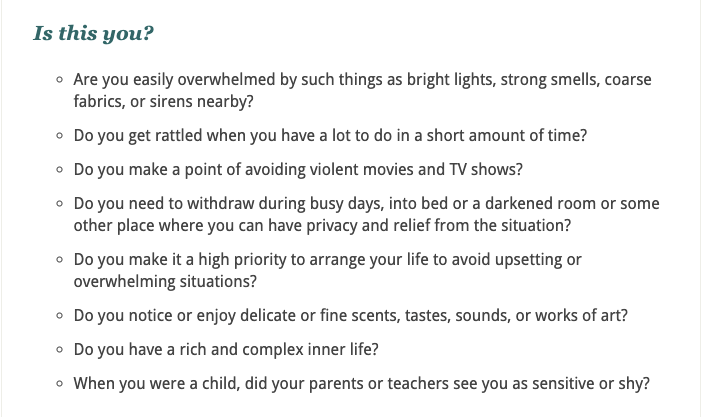
Back in the winter of 2018, I stumbled across a term I hadn’t heard before, but that explained a great deal about the way I experience life: Highly Sensitive Person (HSP). This is a term coined by Dr. Elain Aron, a psychologist, scientist, and researcher, who noticed in herself and subsequently in her studies a natural inclination for about 20% of the population to exhibit heightened sensitivities to sensory stimulation. HSPs have more sensitive central nervous systems, are more easily overwhelmed by sensory input, and tend to take longer to process new information. They have a tell-tale tendency to “stop and check” before entering new situations. Another term for HSP is Sensory-Processing Sensitivity.
Here’s a screenshot from Dr. Aron’s HSP website’s homepage.
I read her book, The Highly Sensitive Person: How to Thrive When the World Overwhelms You, and marveled about how all of the areas I struggled with as a child, and continued to struggle with as an adult, could be fit under this one umbrella term. (I could go into a great deal of detail here about what in particular about my life experience matches an HSP one, but for now, I’m going to stick to chronicling the general timeline leading up to the official recognition of my neurodivergence.)
I began examining my behavior, my experiences of the world, and my past through an HSP lens. A lot of things were making more sense to me, and to an extent, I was able to modify my interactions with the world and other people to be more in line with my comfort zone, which I had been blatantly ignoring or feeling guilty about not ignoring my whole life.
But after a while, I realized something didn’t feel…right. Dr. Aron talked about HSPs as having great gifts and the HSP trait as an advantage. On paper, I agreed, but being an HSP didn’t feel like an advantage to me. It felt like, well, a disability.
This isn’t a word I use lightly. I wrestled with it mentally for a long time, but the more I wrestled the more I felt that, yes, I feel dis-abled (see this fabulous TEDTalk by Autist Jac den Houting in which she says, “I am not disabled by my Autism; I’m disabled by my environment.”) by these traits that (according to Dr. Aron) are supposed to be strengths.
I strongly believe I never would have gotten to this point of understanding if I hadn’t deconstructed the conservative, fundamentalist religious influence, mindset, and worldview I grew up practicing. Some people I know might not like this, might feel off-put, might shut me out because of it, but it’s true, and it’s important. Since about 2016, I’ve been engaged in a long, arduous process of re-examining things I took for granted as truths for my entire life. Part of that has involved learning how to trust my instincts and my lived and inhabited body knowledge. That they aren’t sinful urges to be ignored or temptations to be gutted through. After spending over 20 years ignoring intuition, pushing past my own limitations daily, it’s daunting, trying to reclaim boundaries, self-knowledge, and self-trust. But I was trying. And my lived experience was telling me that HSP wasn’t it. Not all of it. I wasn’t through learning about myself. There was more work to do.
In March 2020, I reached out to a couple of local therapists who claimed specialization in–or at least knowledge of–HSP. I figured maybe I just wasn’t understanding how to work with my HSP traits, that maybe this feeling of dis-ablement could be mitigated by picking up some tips and tricks. Then the pandemic shutdown happened, and I never reconnected with them. There were more important and distracting things going on the in world.
In the summer months, I started to pick up where I had left off. I hadn’t felt comfortable with either of the therapists I’d talked to in March, so I did more googling. I stumbled across this article, which posited that HSP traits in females could really be female Autism. Following that rabbit trail, I found other sources like this YouTube channel run by a British woman who is Autistic. Like me, Sam was diagnosed with Celiac disease, identified as HSP, and finally, sought an assessment for Autism, and found she met the DSM standards to be considered on the spectrum. I found videos like this one in which Autism expert Tony Attwood talks about the characteristics of females with “high-functioning” Autism (commonly known as Asperger’s Syndrome before the update to the DSM-5 removed this label, confusing many and robbing many of an identity they’d come to claim with pride) and of the crises unidentified female Autists go through, including anxiety and depression.
I found this unofficial list of female Autistic traits. I was shocked. I identified with something like 98% of the traits compiled.
I took online quizzes (here and here). With the consistent result: high possibility of neurodivergence and/or Autism.
“You don’t seem Autistic.”
Until August 2020, I would have wholeheartedly agreed. Turns out, the reason I don’t “seem Autistic” has less to do with Autism and my own neurodivergence and more to do with false stereotypes of Autism that are deeply rooted in decades (if not centuries) of sexism and gender discrimination that have affected the very development of the fields of medical science, psychology, and the Diagnostic and Statistical Manual of Mental Disorders (DSM) itself, the bible of psychological “disorders” used to “diagnose” the mental “disorders” we see in the Western world.
There are fundamental differences in how individuals on the Autism spectrum may behave, but until very recently, they have not been recognized. This is due in part to the fact that, when conducting trial studies and tests, psychologists have consistently chosen cis-male subjects. For more on the history of this, and info on neurodivergence in women, I highly recommend Divergent Mind: Thriving in a World that Wasn’t Designed for You by Jenara Nerenberg. This book literally was published in 2020, and would not have been available to me if I had started this research ONE YEAR AGO.
After an intake appointment in which my assessor agreed there was sufficient evidence to proceed, waiting four weeks for my appointment, four hours of testing, two weeks of waiting for my assessor to analyze the data, I learned in a video call that I met criteria for Autism Spectrum Disorder, Level 1 (the lowest level of assistance needed; the DSM-5 goes through Level 3), what would previously have been known as Asperger’s Syndrome, and in a surprise 2-for-1, I also learned I met criteria for ADHD, inattentive type.
Here’s a distinction that’s important: I was not identified as Autistic, ADHD, or neurodivergent by the experts. At age 30, I identified myself, and then sought an expert to officially reinforce what I already knew to be true.
The medical, psychological, and social systems in my life failed me.
This is especially depressing, because as a female, the world had already failed me in so many ways. I was socialized to fly under the radar. I was socialized to “get by” without accommodation, to put others’ needs before my own, and I was smart enough that I could manage. Barely. But the resulting depression and anxiety for constantly struggling to fit into a world where everyone else seemed to fit in easily made life miserable.
I would like to note that my assessor was a lovely person. She was knowledgeable about ASD in women, and delivered the results in a kind, considerate way. At one point, she told me, “There’s nothing wrong with you.” I believe this is true. But I also believe that I am not in the category of what is considered “normal.” She expressed her desire for the day when neurodivergences are understood as a spectrum, rather than disabilities, and I wholeheartedly agree.
ADHD?
I still don’t fully understand the implications of this piece. I haven’t done nearly as much research here. But I do think ASD and ADHD together may explain things that look contradictory, like why I thrive on a schedule, but also have trouble sticking to schedules.
What Now?
As I once again reframe my life experiences through these new lenses, I am heartbroken for the little girl I was, and for the ways my life might have been easier, better, happier. I am also viciously proud of myself for accomplishing things that were desperately hard for me. Singing the lead in a musical. Singing the lead in an opera. Traveling internationally. Graduating with my master’s degree. I didn’t know other people didn’t struggle this much or in the ways I struggled.
My hope is, with this new understanding of how I perceive and interact with the world, I can build a life that allows me to thrive, that makes me happy more often than sad, and that enables me to reach my highest potential.
I also hope I can bring empathy and understanding around the issue of neurodiversity and dis-ability. The experts and Autists I found online were overwhelmingly not-American, and I believe my country is behind on this issue. If you want to talk more with me about this, please reach out. The world is a big, scary, and unsure place. Caring for each other is what makes it beautiful.
*Minutes before publishing this post, I wonder if I’m making the right decision, sharing this information so soon after receiving it myself. I am convinced, though, that staying hidden, masked, and under the radar–the way I’ve been living for my whole life as a neurodivergent person–will not help me or anyone else, and that if I don’t act on the information I’ve received, I might as well not have sought clinical affirmation at all. And, I remind myself, if this makes me feel socially awkward or uncomfortable, that is nothing new. 😉
* This post was edited on January 3, 2021 to remove and reword language including the word and variations of the word “diagnose.” I no longer use the word “diagnose” in relation to my neurodiversity, as it implies an illness or medical condition. Neurodiversity is not an illness. I am not sick.


 Allison Wall